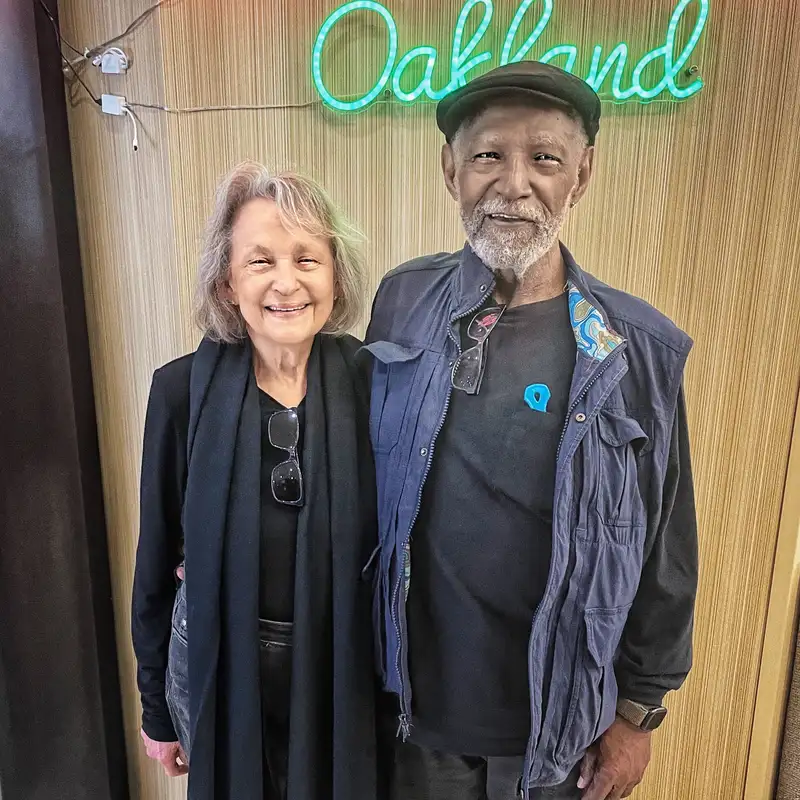
Hello. This is the Island City Beat, and it's Laura Thomas, your host today. We are talking to Jerome Scott and Walda Katz Fishman who are here in the East Bay in January to talk about their book, Motown and the Making of Working Class Revolutionaries, which focuses on Detroit in the nineteen sixties and seventies and the evolution of a group of black workers who were ripe to challenge the society they'd grown up in. Jerome and Walda are both longtime members of the League of Revolutionaries for New America, an organization that developed from a split in the League of Revolutionary Black Workers in the nineteen seventies and has become a national organization of fighters and thinkers. And for me, because I'm a member, a really valuable place to become educated about capitalism and how it created a system that no longer seems to be working for the majority of us.
Laura Thomas:We'll talk about that. Welcome Jerome and Walda. Could you each tell us something about your backgrounds and what drove or inspired you to become a revolutionary and to fight the system?
Walda Katz-Fishman:Thank you, Laura. It's good to be here and hello everybody. So I grew up in New Orleans in really the 1940s and 1950s. This was an intense period of both Jim Crow and white supremacy, but also the period of the rising black freedom struggle that was being birthed in the Deep South. My parents were liberal Jewish folk and were active in the reform struggles, particularly the ecumenical struggles that brought Jewish folk and Christian folk and, you know, the ministers across the board together.
Walda Katz-Fishman:And I learned about the injustice of race from them and from the daily life that we all live. I also saw a real class divide that was apparent, both within the black community and even, you know, among white folk as well, and I came from a family of strong women who all had been through personal struggles and those things combined, the elitism, the wealth, but the injustice in oppression and it set me on a road that I knew something was wrong in the world and I wanted to change it. My parents were activists, As I shared with other people in other spaces, I went to graduate school in Detroit in 1968, which was a year of global upheaval. Being in Detroit, that was radicalizing in and of itself, but for the first time, I am a sociologist and it was the first time as in my theory class that I learned about Karl Marx and this radical analysis of the world that talked about the needs and rights of workers and humanity in the earth and how we were being exploited and oppressed and that just sealed the deal. From that moment on, I was committed to this transformation of the world with working class forces being at the center of what drives this motion.
Laura Thomas:Got it. Jerome,
Jerome Scott:I really do appreciate y'all having us on your program. And I grew up in Detroit. And, you know, I came from a fairly poor, extremely poor background. My father died when I was three and my mother had five children. And she never remarried.
Jerome Scott:She just worked. And so I always knew from the very beginning of being out here in the world that something was seriously wrong. You know, just when you go around the city and you know how you live and you see how everybody else live and you know something is really wrong. But the thing that really turned me around and and began me thinking about. The world and how the world was organized was when I was in Vietnam in 1965, 1966.
Jerome Scott:And I was there for thirteen months. And so all kinds of things triggered my my mind to think about things in a different way than I had ever thought about them before. But the thing that really got me to thinking, We had this detail every day where we had different people go down to the water stream and pick up water for our for the site that we all occupied. And one day when it was my turn, we went down there and on the ground was all these flyers that basically said, Black worker, why is it in Vietnam you walk at the head of the line while at home you're at the end of the line? You know, and and I, you know, it took me a little while to digest that, but that kept ringing in my head, you know, and and I don't know if you really know what that means, but what it means is that in Vietnam, when you go out on a search and destroy mission, there was always a point person was like thirty, forty yards ahead of the platoon.
Jerome Scott:And 80 to 90% of all platoons had black points. So that's what they were talking about. Here you're at the head of the line, the most vulnerable, the most the position where most people get shot and killed, where at home you're at the back of the line where most people get food and shelter and, you know, living conditions are better. You know, so that putting all that together is what put me on.
Laura Thomas:It was pretty stark.
Jerome Scott:Oh, it was really
Laura Thomas:A stark illustration.
Jerome Scott:Yeah. And it really put me on this march toward being a revolutionary.
Laura Thomas:Well, thank you. In this book, you focus on Detroit, where black workers were becoming politicized and how they confront their struggle against both racism and the auto industry, and then racism within the unions who represented them. So this story contains a lot of interviews with people who took part in it. And so that's the, that's the crux of your book. It's the stories of the folks that formed, first of all, the league of revolutionary black workers and then how it evolved.
Laura Thomas:So I wanna know why did you decide to do this book? And I'm interested in how it if you wanna talk a bit about how it helps us to understand our situation, country faces today. Because a lot of people aren't going to necessarily think that, you know, I'm not black, I'm not assembly line worker. It's different now, but in terms of state rep repression and the economic climate for workers with how does this help us?
Walda Katz-Fishman:So the League of Revolutionary Black Workers is a really important expression of the Black freedom struggle of folk who really were first, second generation Northerners from the South going to the point of production. And there are a couple of books that were written about the League, but none of them were written by the people who lived the story. Jerome as a comrade from the League of Revolutionary Black Workers and comrades in the League of Revolutionaries for New America, many of them were those workers and we've been talking for a couple of years, we need to tell our own story and we said, yeah, yeah, yeah, we need to tell our own story And we lost several people. Probably the most important one and what really triggered us getting started was the loss of General Baker, who was an extraordinary leader, a proletarian theoretician and proletarian fighter. So we said, okay, we're gonna do this.
Walda Katz-Fishman:So it was 2015 and his wife, Marion Kramer, we would meet in their living room and pull together some of the comrades and we said we want to get everybody who is still living with us together, we want to do interviews, many of them are Detroiters, so we began contacting people and so on and it was a ten year process altogether and we have about forty hours of interviews, we interviewed close to 40 people and some group interviews, so that was what it was, it was the importance, also you mentioned the lessons, okay, and maybe Jerome wants to share the lessons or, okay, okay, so, there He's giving you a look. A couple of essential I know why. A couple of essential lessons that we really want to lift up. One was the importance of the South, understanding the history of chattel slavery and genocide and white supremacy and how in the six, in '68, when DRUM, Dodge Revolutionary Union movement was first founded, the workers at production and the black students in the schools and the community activists all were dealing not only with your class exploitation and poverty, but they were also dealing with racism and white supremacy.
Walda Katz-Fishman:And it was that this, this journey, this struggle is not over yet at all. So one was understanding how the history of the South and that history becomes a national story and that wherever we are, we need to confront it. The other really important lesson is political education. It's that if you want to change the world, you need to understand the world as it really is. And in school, in the media, we are not taught the way the world really is.
Walda Katz-Fishman:So they went on a very long eighteen month study
Laura Thomas:You know, I wanna comment on that, That to me, maybe it, it shouldn't be remarkable, but I think when I look at this country, I find it remarkable from the time I joined the league and knew that its roots were in the struggle in Detroit amongst black workers. That is where this process began with people who actually understood these things. For the rest of us, a lot of us don't understand. And I'm always truly amazed by that.
Jerome Scott:And actually, that's another reason why we wrote the book. We knew that this little piece of history, the League of Revolutionary Black Workers only lasted for about three and a half years. Right. But the impact of those three and a half years on not only on the rest of our lives, those who were members of it, but the our contribution to the whole development of the revolutionary process. And we didn't want that history to get lost, you know, because no one else is going to tell us tell that history.
Jerome Scott:And the other thing about why we wrote the book is that the auto industry, which was centered in Detroit, was a good example of the way capitalism had developed in the last fifty years. And so we knew that if we could tell this story about the league and also tell the story about the industry that the league was based in, it might give people some good political education about the role of capitalism and how capitalism.
Laura Thomas:You moved right into my next question. I'm going to start my little, little historical lecture for our listeners. Part of the reason we on the island city beat wanted to interview you is to inform our listeners about the past. At the time, the league of revolutionary black workers was organizing in Detroit. The cities in here in the East Bay, Oakland, Alameda, San Leandro, Richmond, even Berkeley to some extent were blue and white collar towns.
Laura Thomas:Alameda had a Navy base and industries that took up its entire estuary shoreline. The prosperity that we knew here in the East Bay, the prosperity that all Americans had in the nineteen sixties. I wanna ask you, what was it built upon?
Jerome Scott:I don't think many people, know that Detroit at during the fifties, well, right after the Second World War, but through the fifties, sixties and seventies became one of the nicest and most accommodating city for workers to live in. We had the highest level of homeownership of any city in the country. And Detroit also had Motown, which, you know, the book is sort of leading toward. And Motown, you know, Detroit became a real cultural center for the world through the voices of Motown.
Laura Thomas:Yes. Thanks for bringing that up. Just in case people have forgotten, but no, Motown people think of music, but it's Motor City is where it comes from.
Walda Katz-Fishman:That's the other art
Jerome Scott:So when you think about that, you think about the incredible and rapid industrial expansion that The United States went through after the Second World War, because The United States was one of the few countries in the world that came out of that war unblemished and the whole world was destroyed. And so The United States became the supplier to rebuild the entire world. And that's what that prosperity was built upon. You know, the auto industry in the fifties and sixties in The United States was the dominant auto production in the world. You know, we The United States produced over, I think it was 70% of all the vehicles produced in the world during that time.
Jerome Scott:So so and the industry, of course, made a lot of money and it employed a lot of people and made a lot of people able to buy their houses. But it wasn't because they were giving us anything, you know, voluntarily. It's because we, you know, we fought to get the advances after the Second World War. The unions were organized and we literally had to fight for every economic advancement that the workers got. We had to fight hard for.
Jerome Scott:So yes, the workers advanced also, but the corporations made billions and billions of dollars through their exploitation of those same workers. And that's the way the prosperity was actually that's what the prosperity was actually based in.
Laura Thomas:So, yeah. So you're saying that prosperity relied on the corporation's ability to deliver benefits, you know, usually through union contracts. Although I like to say that my father, you know, here in Oakland worked for international harvester and he worked in the accounting office. So he's kind of a white collar person. And he used to tell me, you know, he wasn't particularly pro union.
Laura Thomas:He used to say every time they win a new contract in the shop and the factory, we get all their benefits too. So there you go. And they wanted to keep everybody happy, you know, all in all. So, but things began to change in the 1970s, right? So when and how did the league of revolutionary black workers begin to understand this dynamic and how did they explain, strategize around it in those years?
Walda Katz-Fishman:So, a couple, two really important processes were happening. One was the technological revolution, which was being introduced very early on into the auto plants. And so robots were introduced and what that does is it displaces labor and it means that the labor that is left is paid less, but some workers are then pushed to the side. Now in the 70s, the league saw that and as we say in the book, it was at first introduced into the paint shop, and the paint shop was really very toxic, so it wasn't like a bad thing, it was like, it was okay. But particularly as the comrades in the league started to study, they understood that this introduction of automation robotization into the plants was going to increasingly displace workers from production and also drive down the wages of those who are left and that process also beginning probably earlier but especially around the 70s was the process of globalization, right?
Walda Katz-Fishman:So, and I want to say something because I'm from the South, the first stopping point that the industries of the North where unions were very strong, the Midwest, the North, they first went to The US South, where a whole different history of union activity
Laura Thomas:Or a lack of union activity.
Walda Katz-Fishman:Lack of union And activity right, where the ability of racism to keep workers divided along racial lines was much more intense. So I think the automation and the globalization help decimate industry in this country.
Laura Thomas:Yeah, okay. Actually, I wanted to throw in something about the Black Panther Party here. I don't know if it's I'm trying to keep this into some sort of sequence here, but I, I understand that the Black Panthers came to Detroit. What was their goal in coming to Detroit? I mean, did they come from Oakland or did they just form a chapter in Detroit?
Laura Thomas:What was the reaction of the league to them?
Jerome Scott:Actually, the delegation that came to Detroit was from Oakland and Chicago. And. Well, you know, this was in the midst of this whole developing movement throughout the country, where different types of organizations were developing in different places all over the country. And we had written one of the executive committee members, Luke Tripp, had written a pamphlet called Who is the Vanguard of the Proletariat? And it went into this whole question of whether the vanguard was the workers that were working within the system or whether it was the, you know, the lumpin proletarian, which the Panthers definition of the lumpin proletariat was very broad, you know.
Jerome Scott:So whether it was the lumpin proletariat that the Black Panther Party was promoting as the, you know, the vanguard. And and their rationale was because they were outside the system. The system did not hold them back. They could be, you know, revolutionary because they didn't have to wonder about the consequences of being in the system and whether or not they were going to get fired. And so it a little different than Marx's definition of what the lumpin proletariat was, which was that section of the working class that pimped on the other members of the working class.
Jerome Scott:So the Panthers weren't down that line. They were just down the line of we have to be separate from this system in order to fight it. And of course, the pamphlet that Luke said that, no, in order to fight this system, we had to be in the system so that we could disrupt the system because you're not going to bring capitalism down in one fell swoop. You cripple have it first, you know? And so if we can disrupt it in all of our tactics that we, you know, like the Wildcat strike series that we had, if we could disrupt capitalism and weaken it enough to the point where the working class could actually come together and actually overthrow capitalism.
Jerome Scott:So that was the debate. And the way we felt, we didn't want to have a beef with the Panthers. I mean, we didn't think we we didn't think that that was worth our time and effort to fight each other when we were fighting the corporation already and the union already. And so we decided that we would help them form a Panther Party group in Detroit.
Jerome Scott:And several of the people who were members of and one person who was part of the executive committee all joined the Panthers. And they told them they were in the League of Revolutionary Black Workers, too, and we're going to do this thing together. So we never had any beef with the Panthers in Detroit after that.
Laura Thomas:Good. Okay. So interesting. I thought I'd throw that in because this is Oakland.
Walda Katz-Fishman:Of course.
Laura Thomas:So many Americans are aware that manufacturing began to grow abroad in the eighties and the jobs were lost. Is, and then, and what's, and kind of what's happened over the decades is that there are sections of the country that are very wealthy sections that are very poor. So I'm going to just throw this out, this notion that I think comes as a general idea. Many Americans have that somehow this was a necessary result to globalization and that other people in the world developed, you know, were more, there were more modern, were modernized, lifestyles improved somewhat in different parts of the world. But then are we doomed to lose our lifestyle as a result?
Laura Thomas:And what would the league of Revolutionary Black Workers and Lerna help us understand about this? In your analysis that you've been working on low these many years.
Walda Katz-Fishman:Right, low these many So the first thing is that what this period of globalization has done and the automation of not only blue collar work, but white collar and pink collar work here in The United States, in the heart of empire. What that has done is it has begun to erode the wages, the benefits, the access to necessities of a huge swath of working class people here in this country. Globalization developed working, you know, in some parts of the world there was peasantry and they became workers, but it was under really adverse conditions. So, it's true that in globalization, there are, you know, a tiny stratum of workers who are comfortable or had been, but what globalization is doing is driving down the standard of living in the wages and working conditions of workers all over the world. And what we see today in the destruction of our social institutions and the social safety net, which is gone, and the erosion of all the reforms is that that process has brought it home it has meant that if we were the last exploitable section of the world's working class, we are now hitting rock bottom.
Laura Thomas:I think that's a very important point that it's been a decades long process. Right. As in it, I know.
Walda Katz-Fishman:Right.
Laura Thomas:So to some degree, unionized workers to the degree that they still are in unions or are in sectors, they understand the idea of power, needing political power. But what's what has happened? What the orientation has been broken by this disruption in, in digital technology, would you say? Or
Jerome Scott:Well, you know, there are several things about the trade union movement that has changed its fundamental attitude as opposed to when the trade unions were first being established. I mean, a lot of people don't realize because the history books don't tell them. But the the role of communists in building the trade union movement was tremendous. Of the international trade unions in the thirties and forties and fifties before the McCarthy era, you know, most of the leadership was part of the Communist Party or associated in some way.
Laura Thomas:Yeah. That's something that even I haven't fully understood.
Walda Katz-Fishman:Right.
Jerome Scott:And so the trade union movement was the most militant organized labor section of society during the '30s, '40s and early '50s. And then, of course, the McCarthy era came, you know, and one of the things that the McCarthy era wanted to do and had some success with was breaking the relationship between the working class and the intellectuals to make, you know, they thing was, you know, because. With the trade union movement being so militant and being so successful at organizing, a lot of intellectuals drifted and came to and helped build the trade union movement. And it became an important element of the whole process.
Jerome Scott:And so breaking that unity was really important to the ruling class of this country. And that's one of the things that the Maccarthy era did.
Laura Thomas:Talking about the blacklisted filmmakers and all the people who were more, I guess you'd say outside the factory, were supporters and were then intimidated or put, you know,
Jerome Scott:And people who were explaining what was happening in and explaining why the trade union movement was having such an effect on workers to have a better living standard. You know, so they wanted they didn't want that to continue to be reported, continue because it inspired other people to join unions and outside of unions to fight, you know, so. And so that was one thing. Then the second thing that came along later on to affect the trade union movement after the McCarthy era was this whole question of labor and industry being in partnership. You know, that was that whole era in the late seventies, early eighties.
Jerome Scott:And then around the early nineties, the trade union movement invested in the industries that they were organizing. You know, much of our pension funds are all invested in those industries. And that then set another tone for the trade union know, because once they began to get resources back from those investments,
Laura Thomas:Right. Those were basically co opted.
Jerome Scott:Right. Those investments amounted to more money than they were getting in dues. So they became, you know, so when you strike that industry, the trade union, the international trade unions were also affected financially, you know, and so, yes, they began to be co opted in that manner too, you know, and that's why, you know, strikes, they give the company ninety days to prepare for a strike, you know, because they want that pain to be as little as possible. They got to keep fighting. And we're still pro unions, which is explaining why the trade unions are not as militant as they were before.
Laura Thomas:And then you can hear in some people I know who are in unions where they've, you know, had to be in the union from the beginning. Like I had a friend who was a meat cutter and said, well, the union really doesn't do anything. And you want to say, Oh no, don't say that. But it's true in a way the union doesn't actually always stick for the workers.
Jerome Scott:And so, you know, you got to look at it. On the one hand, a very objective obstacle of McCarthyism really affected the trade union movement and jailed a lot of the leadership of the trade union movement. And then down the road, this integration more into the capitalist system. Both of those things had that effect on why the trade unions are like they are today.