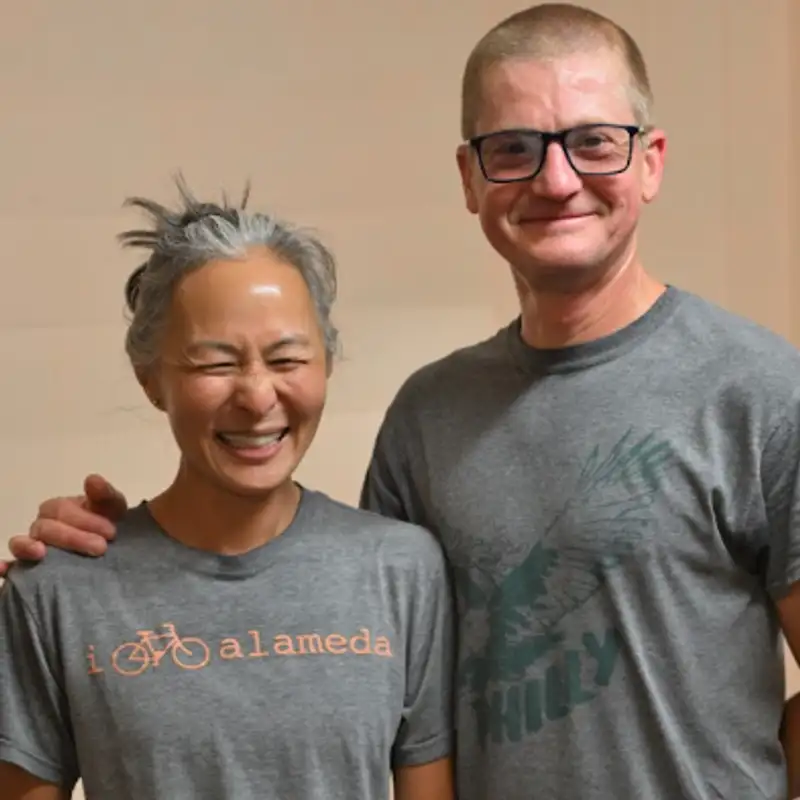
Hello Alameda! Welcome to the Island City Beat Podcast. I'm your host Angie Watson-Hajjem. Today we continue our series of interviews with Alameda City Council candidates. On this episode, I'll be talking to City Council candidate Marcie Johnson.
Angie Watson-Hajjem:We'll talk a little bit about her background, her personal history, her position on a number of topics, and we'll find out why she wants to be our next Alameda City Council person. Marcie, welcome to the Island City Beat Podcast. Thank you so much for being here.
Marcie Johnson:Thank you very much for having me, Angie.
Angie Watson-Hajjem:Oh, it's a pleasure. It's a pleasure. Now, Marcie, you have a pretty interesting background. You were born in Korea. You were adopted as a young child.
Angie Watson-Hajjem:You were by American parents. You were raised here in The US. Tell us a little bit about your personal history, a little bit about your background.
Marcie Johnson:You pretty much summed it up. I came here to America as an infant, as an older infant, and I was raised by white Jewish New York parents. And I grew up in a white world, white middle, upper middle class world, and that I had a I had a lot to rally against. I had a I had to bear bullying for looking different than everyone else. I encountered a lot of antisemitism, and on top of that I was adopted, so very often teased for being not wanted and it was a very difficult childhood.
Marcie Johnson:I would say Angie that I came to terms with it as a young person in third grade and I realized that I was going to have to overcome it or I was going to have to spend a lot of energy combating it. And my choice was to decide that I would get past it and go on with life and and do what I had to do. It did show me though that you can't judge a book by its cover, and it did give me a different way of looking at the world. I was adopted in the 70s so assimilation was the goal and my parents were told that that was the goal And it was a very different existence than a lot of other people, but there are other adoptees who have shared experience. I've made a couple friends here on this island who are adoptees from the same adoption agency in Korea, And we do have a different way of looking at things and a different lens.
Angie Watson-Hajjem:Yeah. Where were you raised? I know you were here in The US. What part of the country were you raised?
Marcie Johnson:I was raised outside of Philadelphia mainly. And then I attended undergraduate and graduate school in Philadelphia.
Angie Watson-Hajjem:And tell us a little bit about your work life, your early years, whether you've done a lot of work with different community based organizations. So tell us a little bit about what you've been doing.
Marcie Johnson:My work life was also unique, I believe. I began in residential homelessness in West Philadelphia at an amazing social services organization called People's Emergency Center. Since I was there in the 90s to early 2000s, it has been transformed because the funding and the mechanisms to serve folks have changed over time. The first big impact was definitely welfare reform during the Clinton industry... During the Clinton administration.
Marcie Johnson:I think that that showed me that number one, helping people with a career, number two, it was very much apparent that along racial lines, individuals in our country have not had equal opportunity and access to things like accumulation of wealth, education, educational opportunities that allowed them to learn. You know, inner city schools in Philadelphia are defunded and and sometimes are running on a very bare bones budget. So it it taught me that, Angie, honestly, that I wanted to equalize the playing field. I wanted to use my skills and my efforts and what I had learned to help communities become repaired or rise up or rally against that on every level from the policy level all the way down to the direct service level.
Angie Watson-Hajjem:Wonderful. You and your family moved here to Alameda back in 2019. What was it that enticed you about our little island city?
Marcie Johnson:Everything. I found Alameda on the internet. We visited and fell in love. West Philadelphia, the community that I was coming from in Philadelphia, had a lot of Victorians, so that was kind of echoed here. It was just a walkable, beautiful community that was diverse and we were transplanting our kids from 3,000 miles away and they were accustomed to a lot of autonomy.
Marcie Johnson:They went to a magnet school and starting at 10 years old, had to travel there on the trolley and the subway. So being located in a place where they could still get around both on foot and with public transportation options and to school was paramount to our decision making, and I'm really happy I ended up here.
Angie Watson-Hajjem:Yeah, it is a great city,
Angie Watson-Hajjem:and I agree. I love that we can walk and bike everywhere. It's all flat, no hills, but easy to get around. So let's go right into some of the questions that I want to pose to you, Marcie, this day. Housing is always at the forefront of every conversation when people are talking about what the community needs, and we have a housing element.
Angie Watson-Hajjem:We're, I think, one of the first cities, at least in the East Bay, to get our housing element approved back in, I think, twenty twenty two-twenty twenty three. We have made some strides in getting affordable housing here. Still have a long ways to go to meet our target. I would love to hear you talk about what you would propose as a City Council member that we do, that you do as the leader here in our city to get more affordable housing made here? Because we all know we desperately need it here and everywhere around the East Bay area.
Marcie Johnson:Angie, I would do anything required. And there are many different ways to get to a point where you are putting a shovel in the ground and starting, but I would do anything that is required. It is complex. It is difficult. I understand that 75% of extremely low income households here in Alameda County are cost burdened, which means that they're paying more than that 30% that HUD defined rent rates.
Marcie Johnson:I understand that rents in East Bay are about 40% lower than needed for housing developments to pencil in, so their development is slow. I understand that here in Alameda, according to, the Social Service Human Relations Board Community Needs Assessment that was done in 2023, that one third of the households here in Alameda have a significant housing burden. So I would do anything that it takes. I've said in forums that I'd work on regional solutions, statewide solutions, but really honestly Angie, anything that is needed.
Angie Watson-Hajjem:I want to talk a little bit about the housing authority. There was a controversy recently where they were refusing to give some tenants over at the Stardust Gardens apartment complex over there at Alameda Point Section 8 vouchers. I think the issue has gotten resolved. City found some money to get the vouchers, to get people housed. But some people think that very strongly that the housing authorities should come under the auspices of the City Council of Alameda.
Angie Watson-Hajjem:What are your thoughts about that?
Marcie Johnson:As candidates, we had time to meet with Jerry Bodine, the city manager, and Jerry and I spent probably a good third of our conversation on this topic because it is close to my priorities for the city. I understand that Alameda Housing Authority has two years to figure out a way to transfer those project based vouchers to the current build out for Stardust Gardens. I recently heard that they would be petitioning HUD for a waiver.
Angie Watson-Hajjem:Mhmm.
Marcie Johnson:I don't...
Marcie Johnson:I'm not sure what happened. The... It was resolved because the city and Abby wrote an excellent staff report, but it was resolved because the city agreed to carry that promissory note forward for the $20,000,000 lost. We need that money. We we are...
Marcie Johnson:We have a a budget to balance in the future, and I am hopeful and feeling confident that will do what they need to do to help us out. As for bringing under to under underneath the city, I would ask Jerry Bodine as our city manager to really evaluate that process. The board is appointed by the mayor, and there should be some type of communication so that we don't have to argue like this in public. I have thought a lot about the board and commissions in the city of Alameda, and I think as council members we should be involved at some level. And I would like to see some kind of system where council members are taking responsibility to participate in boards or commissions that they feel comfortable with.
Marcie Johnson:We can't all be experts in every single topic or interface with every department well, but just dividing and conquering so that we just have that ongoing communication because that's really what it comes down to.
Angie Watson-Hajjem:Here in Alameda, have some protections for tenants, but we're finding we're hearing stories of some landlords here that are going around those protections, like adding different fees on to tenants like maybe you have to pay to use the laundry room or maybe the swimming pool. What is your plan as a City Council person to make sure that our tenants here are protected, that those rent caps stay in place, that we have protections against unfair evictions and so forth.
Marcie Johnson:Working very closely with the rent department, we're lucky to have a very well staffed knowledgeable department. And, Angie, I know this is your wheelhouse. I would encourage individuals to connect with that department directly. As a council member, I do feel it would be my duty if someone brought this issue to my attention to ensure that they were connected with the right staff so that they could be heard and the situation could be investigated.
Angie Watson-Hajjem:I also just want to say a plug for Echo Housing, which is the agency I work for. So we deal with issues around fair housing, tenant landlord, issues that come up. People can definitely contact ECHO if that situation comes up. Thank you for letting me plug that in.
Marcie Johnson:Think part of a Council member's responsibility is to take the intimidation factor out of asking for help. And because of the lens that I come from and because of my collaborative nature, I would be able to work with someone like Echo Housing or Rent Department and just be a conduit for that collaboration so that people are fairly being heard and understanding what their rights are as tenants and as landlords.
Angie Watson-Hajjem:Great, thank you. So Ice have made um They've come to our city. They've come to many cities here in the country. And I just would love to hear you talk a little bit about what is responsibility, if any, that the city council has to protect their most marginal, vulnerable residents here against ICE raids, ICE detentions, and so forth. Because a lot of people are really scared.
Angie Watson-Hajjem:I've heard stories of families not wanting to take their kids to school, not wanting to show up for school meetings because of the possible presence of ICE here on the island.
Marcie Johnson:Education is key to that, Angie, so that families who are vulnerable or marginalized understand their rights and understand how to get help. On a larger scale, I would encourage Alamedans to vote. We're in a fight. We're in a fight for determining at the midterm cycle what will happen next. If people have the bandwidth, go to other counties within Alameda or other states and help help fight.
Marcie Johnson:Governor Newsom passed a huge election protection and pro democracy bill package. Attorney General Rob Bonta is very good with voter protections. And then locally here in Alameda, I know that the Alameda County Commission that handles voter registration and and processes are working to figure out how to ensure that our ballot boxes are emptied because we had a problem last election with it becoming full. But I I would say that as a council member, once again, your job is to be a clear communicator and an advocate for individuals who are in fear and to be open to hearing those stories and being able to, when the rubber hits the road, help people attached to programs and to the many community members in this community who are doing work to help protect individuals who are marginalized and ensuring that they're on the map and they're being monitored.
Angie Watson-Hajjem:Would you support the City Council having a directive to the chief of police not to work with ICE?
Marcie Johnson:I believe that the ICE coordination would actually go through our sheriff's office, not our police office. I think that there have been times in recent history where it's become very tenuous in many cities where a federal law enforcement officer can be pitted against a local law enforcement officer, and that is a... That that... That's a very dangerous situation to be in, Angie. I think that as a council member, it's our job to coordinate with the sheriff's office to ensure the safety and the communication with the feds.
Angie Watson-Hajjem:Okay, thank you. I want to talk a little bit about small businesses. One of the things that we've been doing, our podcast has been going out talking to small business owners here in Alameda to learn about the joys and challenges of entrepreneurship and running a business. People always say that small businesses are the engine of the economy, they're so important. And then we see what's happening on Park Street and Webster Street.
Angie Watson-Hajjem:We see storefronts that are closed, we see businesses that are leaving. And was talking to one business owner who had a cute little shop up near Webster and Central who had to close because the rent got too high. What can a City Council do to help support, help nourish our wonderful small businesses here on the island?
Marcie Johnson:Coordination with Waba/Daba, Chamber, Alameda Point, economic development, and supplement business needs and pivot as needed. I think a good example is COVID. The money that came down from there was used for many different economic development initiatives. It is a comprehensive issue, Angie. I think that we have to work with the landlords as well as the tenants.
Marcie Johnson:I do know that I met with Kathy Weber and she feels the city economic development department is very responsive to small business needs. And an example of that is pivoting and changing the small business loans that are granted. And instead of just that applying to facades, applying to retrofitting interiors and upgrading things to attract tenants. That idea came from that small business community. Really just listening and finding solutions where they intersect kind of like a Venn diagram.
Angie Watson-Hajjem:As far as the rents being raised on these small businesses, we have protections for tenants regarding rent increases here. Do you see a time in the future maybe where we would have that same protection for folks that rent space out for their businesses?
Marcie Johnson:I think that's taken by a vacancy tax. I think that's the way council has tried to get at that end of the candle, you know, burning it from the other side. And I'm not sure if it's legal to exact a rent ordinance on businesses. I would have to look into that and investigate.
Angie Watson-Hajjem:Yeah.
Marcie Johnson:I I... Andrea, I will... I think that you have to use both the carrot and the stick to figure out complex problems, and I wouldn't be... Again, anything it takes. Doing anything it takes that's reasonable and that people can agree to.
Angie Watson-Hajjem:And on that note, let's talk a little bit about public banking. Many cities, including San Francisco, Richmond, Oakland, they're looking at having financial institutions that are owned by us, the government, the people, and the money invested in those public banks would go back to us. It could be used for businesses, for housing, transportation, all that kind of great stuff. If a resolution came to the Council to look into a public bank created here in Alameda, would you support that?
Marcie Johnson:I would consider supporting it, Angie. I can't answer one way or the other. The question I was given in advance for writing was there's a grassroots effort that other East Bay Council members and supervisor Lina Tam have endorsed to create a public bank and what I pushed for Alameda to join that effort. I was able to talk with the person who followed that project on Lina Tam's staff, and having a bank is a big deal. It's not easy.
Marcie Johnson:Would be the funding would come from a general obligation bond. Two thirds of the commitment was supposedly to come from the county. The total amount was supposed to be 1,000,000, so 40 would come from the county and 60 from Berkeley, Richmond and Oakland. Oakland did withdraw from the project. There were risks to the city because of the impact on infrastructure programs so that 100,000,000 would be lent out for cities to do infrastructure projects.
Marcie Johnson:And if Alameda were to put in their share, say they put in $20,000,000 we would lose the autonomy of deciding how to spend that $20,000,000, and we would become competitive with other cities to receive it back. Also, who's running the bank? The board of directors. It can't be community members. It has to be banking and financial experts that have capital project experience.
Marcie Johnson:And the execution of funding that creates the... An entire structure that requires staffing. There's contract execution. There's auditing. There's program delivery.
Marcie Johnson:There's administrative costs. And then if someone defaults, there is risk. So trying to figure out how to cover that risk or if you're able to because if someone takes the money and runs, you really can't do anything. I think that with my work, not here but in West Philadelphia, specifically, are predatory lending practices that financial institutions have. So payday loans where people can get an advance on their paycheck or they have to cash their paycheck, and that business is taking a large percentage of that money or charging an enormous interest rate of 20% or beyond for that advance.
Marcie Johnson:So those are the types of things that perhaps a public bank could solve, but I'm not sure that we have the population in need here on our island. We could work with existing banks to come up with programs, but I'm not sure that the creation of a whole separate system would balance out for us. Okay.
Angie Watson-Hajjem:So we have a wonderful food bank here in Alameda, and I think last year they served almost 12% of the population, so they're serving a lot of people that need help. There's been talk about economic crises that could come with so many things going with the war and diesel fuel going up, there may be food shortages, food insecurity, so forth. Some people are talking about that hopefully that won't be something that we'll see experience but it could happen. What would the city council in your opinion be able to do if anything around massive food insecurity here in Alameda?
Marcie Johnson:We have a lot of people who are working in this community on food insecurity. Councils should be supporting local nonprofits like the Food Bank, Meals on Wheels, Dining Connect, Mastics Foods Programs, All Good Living Foundation. And then I would also include FOS for pets. When I was working at the city and we had unhoused pets, FAS did help with medical bills and food for unhealthy pets. I think there's ways to provide food through programming.
Marcie Johnson:When I was at the city in cooperation with the library, we had a supper and support program where we brought resources to the library on Sundays and provided a meal and people came and I think Angie you were there for
Angie Watson-Hajjem:Absolutely. Wonderful
Angie Watson-Hajjem:And they wanted fun. Yeah.
Marcie Johnson:That they wanted to eat. Yeah. People and they wanted take food home. There is... There are food waste programs here on the island. There are food redistribution programs here on the island. I think from...
Marcie Johnson:I'm very close to Chris Tam. We we speak often and there is enough food. It's just figuring out how to... People throw away a lot of food, a lot of food expires. It's figuring out how to get that distributed in the cleanest way as possible.
Angie Watson-Hajjem:Yeah, I remember during COVID, a lot of restaurants were giving away food that they couldn't sell it. They were giving it to communities, and we need to find a way to take all that food that restaurants throw away, putting it to people's plates. I'd love to see that happen.
Marcie Johnson:I'll give a shout out to backyard growers as well. They collect and they give tons of fresh food to the food bank.
Angie Watson-Hajjem:Yeah, they had been on our show a while ago. They did great work here in Alameda. I love them. So let's talk about crime because often times that does come up as a concern for people. What is your perception of crime here in the city?
Angie Watson-Hajjem:Do you think it's a problem?
Marcie Johnson:I think that people are impacted by crime. I wouldn't necessarily call it a problem coming from Philadelphia. I think that, the police are the city department tasked with enforcing safety. They work for the people, and, I think some ideas about how for how they can work better should be brought forward by the people and proposed by council members. I think they're open to that.
Marcie Johnson:I the police that I've interfaced with in the work that I've done with unhoused population are compassionate and understand where unhoused individuals are and their lifespan. I think presence, community presence, not just in an enforcement type of way, but also as a public servant. I think many of the officers and leadership APD employees are consummate public service employees. I think a good example is Franklin Park. I heard from walking there recently that they're concerned about Halloween.
Marcie Johnson:They've had some shootings in the past and you know, not with people getting hurt, but gunshots and gunfire. And we were going to ask the police to step up and help with additional patrols. That's something that that we expect from the police and would like. And I'd also like to take this time Angie to talk about FLock and license plate readers.
Marcie Johnson:I was put on social media as supporting FLock. I do not support FLock as a company because they have made egregious efforts with, people's privacy, and they've made some really bad business decisions. I do support giving the police tools to help keep our community safe, and that may include technology like license plate readers. The South Shore shooters were apprehended because of license plate readers, and no human being can read license plates, a million license plates in a given month. I want to let people know also that I've posted two reports on my website, one that comes directly from the police about specifically about their APLR readers and one that comes from an HOA at Bay Farm, where they have a cooperative with the police where they purchased four of their own cameras and plugged into the system.
Marcie Johnson:And someone produced a report with APD data saying that their crime rate, their property crime rates went down 71% for certain crimes.
Angie Watson-Hajjem:So you do believe that there is certainly a place for communities to use those license plates readers? You support that?
Marcie Johnson:I believe that now, but the person who produced the report for the license plate readers also said that it is a crime deterrent and if when the contract ends in two years' time the deterrent has been actively used, then there may not be a purpose for that any longer. It's a tool like any other tool that we use in life.
Angie Watson-Hajjem:Let's talk about data centers because, oh boy, I tell you, one topic that's bringing people across political lines together is the topic of data centers. And I would love to hear you talk a little bit about that. What are your thoughts about a data center coming to Alameda?
Marcie Johnson:I watched the June 2019 meeting where Nautilus was put in front of Council and it was not approved for them to come to the point and build. That was the correct decision in my from from my perch. They it was a time when the technology was not a closed loop water system, so they would have been pumping warm water into the bay and causing irreparable environmental concerns and harm. I think that for Alameda Point as a whole, we need a development plan and we need to develop it as a thriving community with housing and public parks and jobs and restaurants and retail and business. And technology for data centers has changed.
Marcie Johnson:I do think that part of the arguments against the last proposal for someone who responded to the RFP is that the transparency isn't there for our voters. I think that we need to start having these conversations together rather than in oppositional polarizing ways because I'm sure everyone would agree that a developed Alameda Point that is thriving is something that the entire community agrees we need to work toward. We have failing museums on on the point. The USS Hornet is is struggling financially.
Marcie Johnson:The Naval Air and Space Museum is struggling financially, and we have struggling businesses. So we have to do something. We have to come up with a comprehensive plan to develop the point. And at this time, I can't say that I would not support the development of the data center or I would support a development I of the data think that you have to look at all the boxes and respond to what the people are saying if it's an environmental concern, if it's drawing too much electricity from the grid. If these requirements aren't met, then of course no.
Marcie Johnson:But again, we have to have open minds to development.
Angie Watson-Hajjem:Lots of conversations and being able to ask questions and get them answered. So I want to talk to you about Oakland, our sister city right across the bridge. There's been talk about a coal export terminal being built in Oakland. And I just want to hear what you think about that. And also, if you're against it, would you support the City of Alameda Council writing a resolution saying that you don't support this coal export terminal being built in Oakland.
Marcie Johnson:Okay. It is my understanding from the research I was able to do since receiving your questions that the Coal Export Terminal is a City of Oakland project.
Angie Watson-Hajjem:Right.
Marcie Johnson:And it has been heavily litigated and the City of Oakland has run out of ways, legal ways in which to block it.
Angie Watson-Hajjem:So at this point the City Council really wouldn't have any weight?
Marcie Johnson:Correct. So at this point the developer is clear to begin. The hope, as many people are hoping about a lot of things, Angie, is that in the next two and a half years, because development is very slow, things will change. The administration will change and perhaps the purposes will change. To me in general though, as a normal person moving around in the world, doesn't make any sense to build a coal exporting terminal here because I don't even know where we're exporting the coal to.
Marcie Johnson:Okay.
Angie Watson-Hajjem:So my most challenging question to you, Marcie, get ready for this. What do you do for fun? Give me a couple of things that you really enjoy doing here on the island.
Marcie Johnson:I run. I volunteer at the library. I babysit my neighbor's dogs. My neighbor Ken works at the library, has three dogs and one of them is a new puppy and I am kind of addicted. I read on my deck.
Marcie Johnson:I take a nap whenever possible.
Angie Watson-Hajjem:Oh, like that naps. Oh, I love naps. So, Marcie, if people want to get a hold of you, they like what they're hearing, how would they go about doing that?
Marcie Johnson:My email address for the campaign is Marcie, my first name, m a r c i e period Alameda@Gmail.com, and my website is marcie-johnson.com, and that's a way to get ahold of me. There's not much separating us as council members when it comes to our values and our beliefs and our love of this community. I would say that what separates me, Angie, is the perspective that I bring and the fact that I am not afraid to ask tough questions. I will push back, and I will push back on behalf of the people who elect me. I also wanted to say a little shout out to you, Angie.
Marcie Johnson:Thank you very much for helping Kathy out tomorrow night at QTAC. I appreciate that a lot.
Angie Watson-Hajjem:Love QTAC. Yeah. Well, tell people what to... QTAC is for those who don't know.
Marcie Johnson:Yes. QTAC is the Queer Teen Alameda Center. That was a project I developed when I was a city employee, and it was a collaboration between Alameda Collaborative for Children, Youth, and Their Families, which is a group that was started by Lena... I'm sorry. Wilma Chan in the nineteen nineties Right.
Marcie Johnson:And Alameda Pride. I will also put a little push in for the Alameda used book sale that's coming up in the Stafford Room of the main library, 1550 Oak Street. It will run from Wednesday, October 14 to Saturday, October 17. On Wednesday, five dollar bags for teachers all day long and a special musical performance by one of our sponsors, School of Rock from six to seven.
Marcie Johnson:They'll be bringing their youth house band. I'm really looking forward to it. And then on Saturday, five dollar bags for the entire community.
Angie Watson-Hajjem:A lot going on here, a lot of things people can do. Well, Marcie, it's been a pleasure having you on our broadcast. Thank you so much for coming and sharing your thoughts, your opinions about the numerous topics I brought your way. We appreciate the conversation.
Marcie Johnson:Thank you, Angie. I appreciate you having me on, and I hope to have your vote in November.
Angie Watson-Hajjem:Thank you, Marcie, and thank all of you for listening in to our podcast. Thank you so much for joining us and tune in pretty soon for a new podcast coming your way. Until then, I'm your host Angie Watson-Hajjem. Take care everyone. Bye bye.