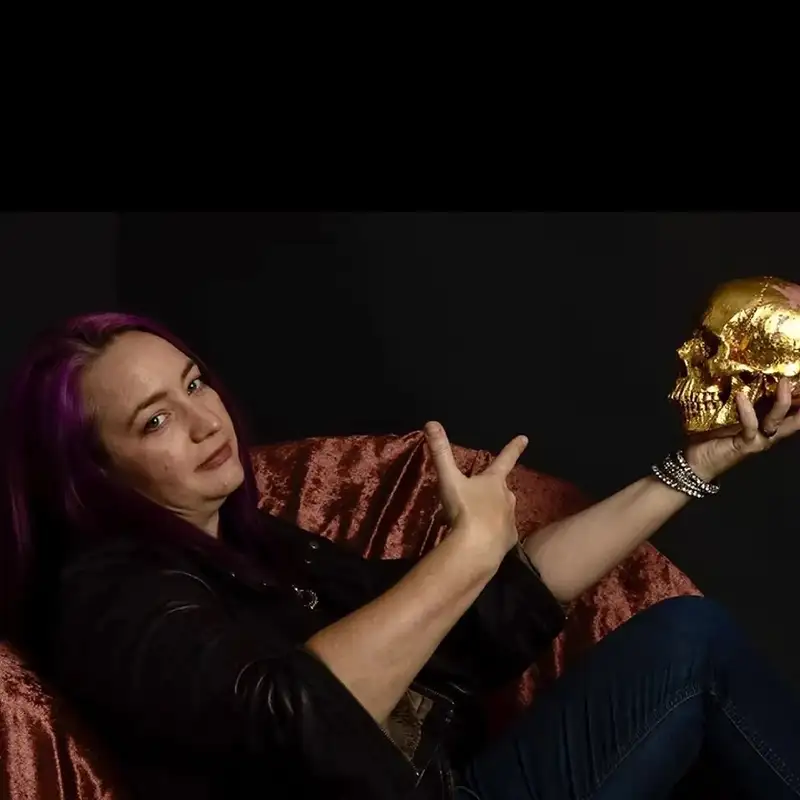
Hi. This is OK speaking. I am Island City Beat's new art critic, and I want to introduce my approach to seeing. There are things that catch my eye. Halloran or Halle Perry lives in Alameda, but her art studio is in Jingletown across from the Park Street Bridge.
O K Boomer:These snapshots of the area were on a wall mural around the corner from her studio. I also took snapshots of this boarded up old warehouse near the wall mural. I use snapshot aesthetics or fast seeing, like a slideshow. Snapshots are mostly real seeming, but snapshots can evolve. Snapshots can lose reference.
O K Boomer:Snapshots can become abstract. I like to shoot this old door handle on a 1950s Chevy. I see both the handle and and its abstraction when it's magnified. This is Halle's Street. I see her studio building.
O K Boomer:I see the street bush tunnel. This is a guided journey through the bush tunnel. This snapshot journey rests upon by far more people create snapshots than any other visual art. Once all these people decide to create snapshots together, watch out. I really see here just how different snapshots are from conventional art or fine art and that it just waits for bigger voices to emerge and explain who we really are using these tools.
O K Boomer:Hi. This is O K Boomer with Island City Beat, and I'm here to talk to an artist.
Halloran Parry:This is Halloran Parry. I'm an artist in Alameda, and I'm here to talk to Okay Boomer about art.
O K Boomer:Snapshots are full of attention grabbers, and here's one that Halle talks about. Is for me is we discussed a little bit a painting over to my right. Can you tell me why that painting is important to you?
Halloran Parry:You're talking about Pygmalion. I did this painting about six years ago. This is about the myth of Pygmalion, which is in broad strokes an ancient Greek myth about a sculptor who falls so in love with the piece that he's working on that he petitions Aphrodite to bring it to life. And there are a lot of interpretations of this myth. Most of them are fairly misogynistic, but I always looked at it as the experience of an artist being so invested in what they're working on that their whole identity lives or dies with the success of that project.
Halloran Parry:And when I did this particular piece, I had just bought a project car off Craigslist. I knew nothing about cars or how to fix them, and I spent a lot of time with it in pieces on the floor of my garage not knowing if it would ever go back together. And so I turned myself into a robot mechanic, and I turned the car into a robot, and this is the moment right before the mechanic realizes that the robot works or that Aphrodite has brought the thing to life because I needed to paint some hope. I needed to paint a happy ending and a path forward and I will say now it's six or eight years later and the car works great and we take it to track days and it very fast and impresses a lot of people. It has a happy ending.
O K Boomer:So to frame this, I'm really interested in you because you're doing something that I think is really important, which is you're using words to make your pictures from. Can you tell us a little bit more about that? And I might have some more questions.
Halloran Parry:Sure. I think a lot of people think in words. I think a lot of people have great stories to tell, and they they think about the narrative in in language. And they don't necessarily think about what that translates to in an image. So I get them to tell me what's bouncing around in their head, and then I do the work of of translating that into some sort of visual allegory.
Halloran Parry:So for example, I was just talking to somebody who he's looking at his life's work, he doesn't know what matters. And he's feeling like nothing matters that he's done after years of building successful career. I know him professionally. I know his work. I know it's great work.
Halloran Parry:It breaks my heart that he's not looking at it and saying, well, it's all worthless. And so I was thinking about lenses and all the different ways, all the different lenses that we use to look at our own lives, which is what I started drawing here. I started drawing a bunch of broken opticians' lenses as a way of thinking about how this guy had a way of looking at his work and his life, and that was one way. And now he's looking at that saying that was the wrong lens. So he's picking up a different one.
Halloran Parry:I don't know if that's the right lens either, but I'm fascinated by the fact that he's trying a bunch, trying to find the right thing to make sense of everything he's done. And so I'm not here to make sense of his life and his work, but I can give him some structure around the process he's going through to get there.
O K Boomer:So, Halle, what can you tell us a little about your background? What brought you to this?
Halloran Parry:I went to school for fine art in the early two thousands and looked around at the landscape and decided that a double major in computer science would probably be a good idea if I wanted to pay bills. So I went off and worked in tech for twenty years as a software developer. But I always wanted to make art. That was always the plan, so I saved up a lot of runway. And then about two years ago, I quit the software industry completely, and I've been working full time as an artist ever since.
Halloran Parry:Well, I I find it fascinating how people's minds work differently, how people we all have different ways of thinking about the world and reasoning. One of the fun facts going around the illustrator community right now is the the inner eye and how different people experience that differently. Some people have a very strong inner eye, and you say picture an apple, and they can see the apple. They can see what color it is. Some people can't do it.
Halloran Parry:Some people are on the spectrum in between. I get little flashes of an apple, but nothing enough that I can really remember and pick out what it looks like. It's just very sort of instant and ephemeral. And I think it's the same with words. Some people think in words.
Halloran Parry:I tend to think in terms of sensation and memory and feelings. That's that's how I remember certain things. And so when I look at somebody's face, I don't typically hear words in my head. I I feel feelings or I remember a piece of music or I, you know, have some memory of some other time and some other story. So it is up to other people to find words in my work because that's not where I start.
O K Boomer:That's why I think, especially because you're trying to do it on a single picture, that you're really exploring things that graphic novelists are they explore, but they don't think of it as one single picture. So go ahead. Riff. Play jazz for me.
Halloran Parry:Yeah. I I mean, you're right. And and graphic novelists are some of the hardest working artists out there today because they have to create so many panels to tell a story. We say a picture is worth a thousand words, and it is, but 10,000 words become a lot of pictures. And you tell different stories with words than you do with pictures.
Halloran Parry:I think one of the most fascinating forms of storytelling right now is actually the Internet meme. I think that people have gotten so good at taking some piece of pop culture, throwing some different words on it, and identifying a really specific experience, that that's relatable, that's identifiable. I think it's a master work of art. And I'm not quite looking to go that far, but I do want to evoke a mood. Like, all of these spheres up here, they're all meant to evoke moods the simplest way possible, just with with a lighting sphere.
Halloran Parry:You know, this comes out of video games where you're just trying to figure out, well, what's this gonna look like in three d in this light behind these things? I'm like, well, what what does fall feel like? What does it feel like when all the wildfire smoke, arrives in the Bay Area and the sun doesn't shine for three days? What does it feel like in summer when everything's really green and verdant, which is something we don't get much in this part of California? What does it feel like in winter when we're all stuck inside because it's raining and everything's cozy, I hope?
Halloran Parry:Like, what are the textures? What are the visuals? What are the colors? What are the contrasts? I love exploring that.
Halloran Parry:And I don't wanna replace words, but I wanna say something that goes along with words that the words can't say. Illustration's fascinating to me because it's it's imagery that serves a purpose. It has to get a message across to a viewer. And whether you like it or you hate it, that's its goal. And illustration people who are illustrators are experts at readable images.
Halloran Parry:The art schools, that's what they're teaching is how do you get an idea across? And I think that is the secret sauce that illustration does really well that I wanna take. Illustrators still have to know anatomy. Illustrators still have to know perspective. Illustrators have to understand a value structure.
Halloran Parry:I don't have to be able to paint a perfect likeness. I'm not a portrait painter, but I have to get you to know that that's a person dealing with a robot. I have to get you to know that that's an abyss and there are water striders on top of it. Right? That's my goal with any painting.
Halloran Parry:I have a lot more freedom to explore some strategic abstraction, to explore shape language, and I love that freedom of fine art. But I do think that having a point to your image and then working to get that point across to the viewer is just basic respect for anybody. I think you should have a prayer of knowing what my art is about or at least finding something to grab onto so that you can go from there and interpret it better. I don't I don't wanna leave you totally lost and adrift in in a visual language that makes no sense.
O K Boomer:So, Halle, do you sit and paint, or do you do you stand and paint? The reason I'm asking that question is because one of my favorite examples in my life that knocked me off my feet is my friend Ted puts the canvas down on the table and he paints over the top of it. How do you how do you approach the picture?
Halloran Parry:Well, I start with big shapes. And for this, I stand. And, typically, I will have had a sketch in my sketchbook. I will use, it's called the camera lucida app to transfer it to something this big, and then I'll paint standing. When I get to small stuff, what I will do, I will sit, and I have built myself a retractable mall stick.
Halloran Parry:So I can rest my hand right here and paint very steadily. If I ever have to do pinstriping work, which happens occasionally or or very fine detail, then I want as little movement as possible, so I'll sit for very small shapes. It's also true that in this business particularly, if you're fiddling with around with very small shapes, you may have sort of lost the plot a bit. So I try not to do that too much.
O K Boomer:This is okay speaking. We're looking at a quiet version of Hallie painting. She's wearing a glove on her painting hand and she's painting offshoots from the main body of the forms that are curved branches off of these main forms and they assume spiral shapes. She's using oil paints so it's a nice picture of what an artist does To paint.
Halloran Parry:Do have what you needed? Do want me to keep going?
O K Boomer:Got what I needed.
Halloran Parry:You know, I I started this because I think people are important. I think stories are important, and I have my own view of of why they're important. And I don't need an algorithm to tell me that. People's stories are important because they come from people, and people matter. And they don't need to be big.
Halloran Parry:They don't need to be impressive stories. They don't need to be high impact stories that touch a lot of people. They just need to be stories. I talked to a woman who is wrestling with growing up in the nineteen sixties outside of Las Vegas, and that environment for her included a lot of, frankly, very sexist imagery, it being Las Vegas. And she said, you know, I'm I'm trying to reckon with all that now.
Halloran Parry:I'm trying to understand what memories I've been left with and and how they've shaped who I am today. But, also, I don't feel like that's even responsible to do given what's going on in the world and how many more important things there are. And I you know, that's scary to me when people say that because big things come from small things. There's a there's a systems line. Forget who wrote it.
Halloran Parry:You know? Complicated systems that work start from simple small systems that work. And so we as individuals are the small systems, and we we have to start working on ourselves at a small local level in order to have this grassroots rising of stuff that works at regional levels, at state levels, at national levels, at planet levels. Right? And so my little role in this is, like, let's find ways to make the small stuff work so that we can build bigger, better things, and we have a better ground to do it on.
O K Boomer:So thanks, Halle. I I'm really enjoying this myself, and I I understand you are enjoying it. Tell me about that.
Halloran Parry:I think it's fun to talk about art. I think I get into the really nerdy side of of the real world. I enjoy the physical world. I enjoy experiencing the physical world. So over on my tool shed is on my tool shelf is, like, raw pigment from occasionally, I make my own paint.
Halloran Parry:I'm always exploring tooling. I'm always exploring how to do things better and more precisely and and why the world works the way it does. I am married to a guy with a physics degree, so we talk about how the world works a lot. You know, we talked about what does a camera do versus what does painting do. Right?
Halloran Parry:Well, a camera, even in the land of HDR, it irises for one one lighting scenario. You know? If you meter for for the highlights on an object, you're gonna get very dark unreadable shadows. As a painter, I can fill those shadows in. I can explore a wider value range, and I can give you more information and still make it readable, and I love knowing that.
Halloran Parry:I have a book about the intersection of art and science through history. And one of the things I find fascinating is that there was a period of time in human history where we had we had no sense of causality. We had no sense of time. We had no sense of before and after and the causal relationships between things. And when you don't have a concept of causality, you don't have stories and you don't have writing, and you don't have narrative, and you don't have, quite frankly, cause and effect, which makes it really hard to reason about, say, why things happen.
Halloran Parry:So that's the kind of stuff I get into, and I just I think it's an amazing view into human history and into who we are today.
O K Boomer:So here I am looking at her painting that I saw her painting on the last time she was here. And what's nice on the easel is Joseph Campbell, which is sort of what she uses as a touch Stone to think about how words add to paintings and pictures. And this is just something that she put up there to tell us what she thinks is the value of her work. Can you talk a little bit about why oil paints are important to your craft here?
Halloran Parry:I will use whatever. I've used acrylic. I do a lot of sketching in watercolor, but I like I mean, we'll get super nerdy here. The pigment load in oil paints is about, I think, 40% pigment to medium. The pigment load in acrylics is higher, and then it gets higher still as the water evaporates.
Halloran Parry:And that weirdly gives acrylics a duller look. Whereas with oil, you can get a much more reflective surface, you can get a much more vibrant surface, And I have the luxury of time, so I might as well take advantage of it and use something that's slow drying and malleable. I just like the look of it.
O K Boomer:Wow. So this is Okay Boomer, and I'm signing off for Island City Beat. Thank you, Halle. Really, really liked our conversation. Have a great day.
Halloran Parry:You too. Thank you.
O K Boomer:I like the brush strokes in this painting by Halle. This image is from her series Season of Emergence from 2025. You can find her website at halloranparry.com.