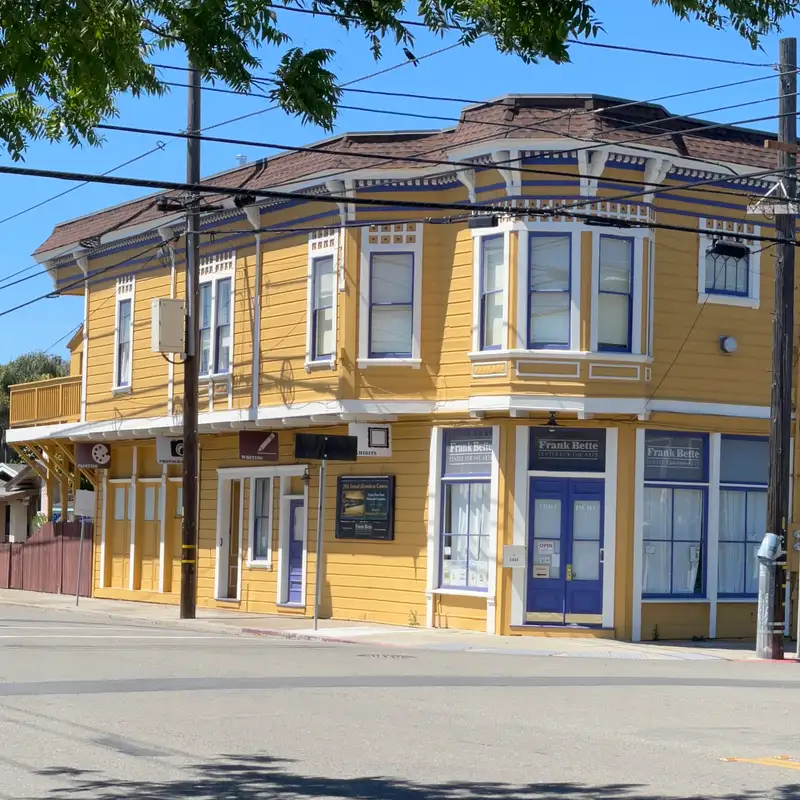
Hi. This is Okay Boomer, the new art critic for Island City Beat. The Frank Bette Center for the Arts has a new show called Alameda on Camera. I am talking to Taggart Gorman, chair of the show presentation.
Taggert Gorman:Hi. My name is Taggart Gorman. I'm the chairman of Alameda on Camera. This is our twentieth anniversary of the show. Here at the we're at the Frank Bette Center in Alameda, California, and we are currently in the main gallery of the Frank Bette Center.
Taggert Gorman:This currently right now, you can see we have all the art for this year's competition. We also have the back room, the spotlight gallery, I think that's what we call it. I forget. But also the back room, we have more art back there. Alameda on Camera is a juried event where we select 48 photographers.
Taggert Gorman:They have forty eight hours to roam Alameda taking pictures. And as you can see over here, each photographer is assigned a map, a part of the map, I should say. There's 48 regions, so each photographer draws a number out of the hat, and that is the area in which they spend their forty eight hours. This year, I forget the exact dates, but it was at the end of February from Friday at 9PM to Sunday at 9PM. The artists can do whatever they want.
Taggert Gorman:It's a photo based competition. It doesn't mean that they have to, in the end, provide a photograph. If you come to the vet or if you see in our pictures here, you'll see that there is a lot of art on the walls. But at the same time, we also have sculpture. We have, there's a light box over here.
Taggert Gorman:There's a mobile. So what we want our artists to do is start with a picture and then go wild. So we encourage the artists to create whatever kind of art they want. And this year, like every year, we get a wide response. There are a lot of photographs, framed photographs, but at the same time, we have other things.
Taggert Gorman:One of the pieces this year, actually, I learned was actually three d printed.
O K Boomer:What's your name?
Mike Gifford:Mike Gifford.
O K Boomer:I'm I'm with Island City Beat, and and you just started talking to me about your photos that are at the Frank Bette Center right now, a three d picture. Tell us a little bit about that. I I can actually reach out and touch it,
O K Boomer:but but you want this.
O K Boomer:So so why'd you first off, why did you get into this?
Mike Gifford:Okay. So, you'll notice right off the picture doesn't have glass over it because I wanted to allow people to actually do what I told you, allow you to touch it because you get a sense for there's something physically there and I titled this picture something different because I didn't think anybody else would be converting a two dimensional picture that they took into a three-dimensional item that they printed. And it's totally different.
O K Boomer:But you're a realist, but you're doing things that most photographic realists don't think about very much.
Mike Gifford:Yeah. I mean, what this forces you to think about when you take a picture, and whether it's monochrome or color, The way a printer works a printer doesn't know colors. A three d printer is loaded up with filaments of different colors, but it doesn't know what color it is printing. It just knows the material and how hot you get the heat element and then pushes it through and it squirts it out like toothpaste on a on a printer bed. Okay?
Mike Gifford:So, it's completely different And then the output becomes a photo. That's three-dimensional. You're actually thinking about it as though you're you're printing with filaments that are like paintbrush and a canvas that you're paint painting on because in painting, you layer the paint down and then create the image from that and if you, for instance, you take a white and an orange, you might get a very light white or a pink, you know, pinkish kind of color by mixing two or three colors together. That's exactly what we're doing here.
Taggert Gorman:So it from a distance, it looks like a picture or maybe even, something that was painted, but it turns out it was actually printed on a three d printer. So this is the kind of creativity that we really encourage of our artists. Another piece that we have this year is up here where we can see it's, it almost looks like it's printed on maybe a vinyl or a plexiglass, but I talked to the artist in this case here, and it actually is just a printer. A regular printed on, obviously, nice paper, but still it comes off to me as something more than just a print on a paper. Like I said to me, it almost looks like it's popping out of there, printed on, like I said, plexiglass or or even glass for that matter.
Taggert Gorman:Then also, like I said, since we are a photo based competition, we don't expect someone just to take a picture and then print it out. Like this example right here, we can see that there's actually it's a three different photos combined into one. I don't know if you necessarily wanna call that a triptych since they're all in one frame, but this is the kind of creativity that we encourage. Not to say that we don't love just a regular photograph, like this one up here where we have the ferns growing out of a hole in what appears to be the sidewalk or something like that. Once again, I talk I don't talk to every artist, but I I talked to some of them, and he told me that this is exactly how he found it.
Taggert Gorman:There's no Photoshop involved here. This is just a scene in Alameda.
O K Boomer:It has a red dot on above the the nameplate.
Taggert Gorman:Yes. That means it's been sold. So any piece of art you see here that has a red dot means the art was sold. So this year has actually been pretty good because we can see that there's there's five right here. I've heard that all the youth photographs, which we'll talk about in a second, all those have sold.
Taggert Gorman:A little more vacant over here, but everything part of everything submitted to the competition is for sale. Sometimes the prices are a little high. Maybe the artist doesn't really want to sell it, but it is part of the agreement or or conditions of the contest that everything you submit is for sale. And so also, we can see that we encourage all different sizes of art. We've got bigger pieces.
Taggert Gorman:We've got smaller pieces. Even down here, we've got some very small ones. And on these, we can see that the artist is actually painted on top of that. Or yeah. I believe it looks like it's painted.
Taggert Gorman:So once again, this just goes to show, you know, the level of creativity we're encouraging. Going back to the main competition, these three pieces here really show just kind of the immense creativity that we get from our artists. So for those of you that might just be listening, we have three different photos, including quite a large one of people wearing a large rabbit head. I know it sounds strange, but that is what the artist has. But these are people in what you could almost call normal situations, sitting in a chair by, you know, a flowering tree or on a slide or this one almost oh, for a minute, I thought it was at the beach.
Taggert Gorman:But so this is the kind of creativity that we encourage. Thinking out of the box, finding interesting scenes. Obviously, the person with a rabbit head wasn't just sitting around in Alameda. The artist created it, but still. So let's continue on to the back into the signature gallery.
O K Boomer:Alright.
Taggert Gorman:Okay. Alright. Yes. All along here we have more and more. We've got this big table here so often times the smaller pieces we'll place along here.
Taggert Gorman:But as you can see once again Alameda has a wide range of basically subjects or topics you can come up with. We oftentimes get beach photos, birds, obviously. Alameda has a lot of birds, more beaches, sunsets. But at the same time, we have one of the photos here that, yes. This was the historic Alameda.
Taggert Gorman:This was taken in one of our coffee shops. I believe that's, Jim's coffee shop.
O K Boomer:So, who are you?
Aisling O'Callaghan:Yep. Aisling O'Callaghan, Alameda resident.
O K Boomer:This is a
O K Boomer:photography show. Yes.
O K Boomer:Where were you in the city photograph?
Aisling O'Callaghan:I had Area 23
Aisling O'Callaghan:Which is actually kind of a lively area. It's got a a different contrast. It was the Alameda side of the Park Street Bridge down to Walnut and over to Lincoln. And that was my area.
O K Boomer:Tell me about you know, one of your pictures.
Aisling O'Callaghan:So Jim's Coffee Shop Jim's Coffee Shop is I knew I wanted to do something with Jim's because it's an Alameda institution, and it was in my area. And I went in there on Saturday, probably for about two hours, with permission, and it helps me in a show. And I was I was really taking the waitress because I was ordering food and, you know, when I was there. But then the head chef also said, hey. Will you
Aisling O'Callaghan:take some pictures of me? And I'm like, absolutely. So I was there on the Saturday for about two hours And then I got back and I looked at some of the photographs and I'm pretty good.
Aisling O'Callaghan:I did it, but I went back on Sunday And it's just about movement. I like people. It's it's it's a community space because people are talking to each other as well.
Aisling O'Callaghan:So the photograph I took, have Brandon, which I know that's the name he goes by, but he has a birth cert name, which is different. And then I was sitting down and I just saw these two, what looked like working guys sitting at the counter on a Sunday morning. With the with the painting on the back wall in Jims, it just smacked a coffee shop.
Aisling O'Callaghan:The stools at the counter, and I I just liked it because they were in their own world having their breakfasts doing their thing
O K Boomer:Diner is a great subject matter. So now I'm gonna blank in this guy's name Edward Hopper, but he was in the 30s. And then the famous picture of standing outside a diner looking through the window at the customers and the isolation and all that stuff resonated the hell out of out of that culture at that time. And here, I think you're also of your times. That is
O K Boomer:There's for one of a better way of saying it, we're in an extraordinary period.
Aisling O'Callaghan:Yes. We are.
O K Boomer:So I like your work. How Where what's your background? Can you tell us a little about . Where you come from as a photographer?
Aisling O'Callaghan:Well originally Irish and my parents gave me a Nikon FD my first camera for my 21st birthday which I still have and it still works.
O K Boomer:I like that durable. You can't get nothing like that anymore.
Aisling O'Callaghan:You can't. So for that would be so I was in a camera club in Ireland. I did development in Ireland before I moved here. But then when I moved here, it was more into snaps. Kind of just snaps.
Aisling O'Callaghan:Finally, I've definitely my family go, oh, thank god somebody took pictures in the family. I like people. I like people in my photographs. However it is, they they're not a distortion. I don't want this clean image. So ideally, want somebody walking into my photograph.
Aisling O'Callaghan:I want somebody in a picture. Then I also like black and white. And I struggled with this one, whether I would do it in black and white with the back scenery. The back scenery just the colors just resonated.
Aisling O'Callaghan:so, I'm just making sure I'm practicing and I'm getting that.
Aisling O'Callaghan:And by submitting and by printing and getting the truths, that's how it's gonna grow.
O K Boomer:Yeah Yeah. I it's one of the first things that I saw when I came in to look at the show weeks ago.
O K Boomer:And that's my style. That's a snapshot.
Taggert Gorman:Yes. Exactly. And that caught the jurors off. And so once again, it just kind of goes to show that by bringing in 48 different artists, and every year, it's a different, I mean, we get some returning artists, but also every year, we get maybe about half returning artists and half new artists. And so that brings a nice, you know, kind of mix, a new eye to the show every year.
Taggert Gorman:And also, think it helps encourage creativity for the the artists that have been here before. Maybe they'll see something new, you know, a new perspective or maybe even a new way of framing or a new way of photo manipulation. And so this kind of keeps the competition constantly moving forward. You Know, I'm just trying to think of that example there, but it lost my mind. So looking over here, once again, also also Alameda is quite the city of flowers.
Taggert Gorman:So we always get a lot of art with, you know, the amazing, you know, greenery that we find here in Alameda. And this actually is one of the pieces of art this year. So as you can see, like I said, we could, you know, sculpture. So within this book here is some of the photos the artist took. The artist actually made a book of this area.
Taggert Gorman:So this is called the shipways. They actually used to build ships here in Alameda, and they would build them on top of this building. And so this artist, his name is Andy, this was his area. And so, actually, he wrote up an entire book on the area. You can see there's, like, a little bit of the history here, and then there are the pictures that he took.
Taggert Gorman:He's like, cute, See, he's got his feet in there. And this was one of the pictures that we saw before. I mean, one of the artists we saw before.
Taggert Gorman:So this is the kind of, you know, just fun little thing that gets created at Alameda on camera. You know, a little book of photographs.
O K Boomer:Fantastic. I you know, I I've been in here
O K Boomer:four times to look at the photographs, and this is the one I overlooked.
Taggert Gorman:Well
O K Boomer:And I is really nice.
Taggert Gorman:It's something a little out of the ordinary you might not quite know off the top of your head. I mean, since most things are framed pieces, you might not see that that is actually a piece of art. In fact, I just say, please read the book.
O K Boomer:This shows to go how carefully I read the captions.
Taggert Gorman:Oh, well, you can come in here a dozen times and you'll still discover something new. It happens to me every single time too. Some like, really, this this picture here today is really catching my eye from the popping of the color of all those, you know, construction. I wouldn't call them cones. I'm not quite sure what you call them.
Taggert Gorman:But, you know, did I really look at that one before? No. I probably, you know, didn't really. And the same with this one here, the flying stuff. That one is just now catching my eye.
Taggert Gorman:So I don't remember exactly how many pieces we have hanging this year, but we are, I think with 48 artists, every artist is guaranteed one piece to hang, but we encourage them to submit multiple pieces of art. And, generally, each artist gets two or three pieces. Like I said, no guarantees past one. But so there is at least a 100, if not close to a 150 pieces of art
Taggert Gorman:hanging, or in some cases, like the mobile air sitting and hanging.
O K Boomer:Juanito, what's your name?
Juanito Ellingson:Juanito Allinson. I am one of the participants here at Alameda Camera. My zone was Zone 24.
O K Boomer:What am I looking at? Tell me. Which ones are yours?
Juanito Ellingson:This one is mine up here. It's called Alegria. I named it Alegria because Alegria means joy. And I just there's a lot of happiness with him throwing the sand. He's having fun there.
O K Boomer:So I'm gonna be interviewing him. He was using a telephoto. What kind of lens were you using?
Juanito Ellingson:I was using a Leica R full manual lens.
O K Boomer:So when we last talked you talked a little bit I think you sort of pay attention to lenses and stuff like that. Why?
Juanito Ellingson:I just like vintage lenses. I feel like they give you more of a different aesthetic look than these newer ones because these newer ones are very, very sharp. But with these older ones, you get a little bit, you know, little nostalgia there.
O K Boomer:I like those little details that kinda show that, you know, know what you're talking about. So tell me about this one right here.
Juanito Ellingson:So here, I was actually using a telephoto lens here, and I captured these pelicans in motion with Sutro Tower in the background.
O K Boomer:So you said you were looking at the textures. Textures. Tell me about the textures.
Juanito Ellingson:Textures like the water and even the textures in the feathers of these birds, the texture of the water being splashed.
O K Boomer:Is there other pictures that you shot out here?
Juanito Ellingson:There is. There's actually one back over there.
O K Boomer:Okay. Let's go take a look.
Juanito Ellingson:So this one here, called La Costa at the beach. I kept the 2 people walking on the beach. I just really love the texture of the sand and the footprints.
O K Boomer:It must be pretty important to your heart.
Juanito Ellingson:Very. Yes.
Juanito Ellingson:you put
O K Boomer:just energy in it.
Juanito Ellingson:Yeah. Oh, yeah.
O K Boomer:Tell us about that.
Juanito Ellingson:So I I just have a very I'm very passionate about it. I'm capturing the moment. I always say that, you know, that's how I want people to remember me by seeing these images.
Taggert Gorman:So in addition to the regular 48 artists, every year we also have a youth artist competition. And this is available for anyone up until high school. Most of the time it is just high school students, but there is no lower limit. I know that we occasionally had younger artists. When it comes to the youth artists, we ask that they only submit two pieces, and we also ask that they don't frame the art.
Taggert Gorman:This way, you don't have to worry about, you know, somebody in high school coming up with a $100 to get a nice frame. Up here on the wall are all the youth submissions, and this year we had six competitors. Since there's only six, the island is divided up into much bigger chunks for each one of the youth artists, but they still have to follow the same rules. You know, forty eight hours from Friday night to Sunday night must be in your location, and then once you are done taking your pictures, you are free to manipulate them in any way. But like I said, in the case for the youth artists, they are allowed just two 5x7s, so you don't have to worry about framing them or making them bigger or smaller.
Taggert Gorman:This year, as we can see, talking about the red dots from before, every single photo of the youth artist has sold. So it's good for our youth artists. It encourages them to keep working on their art. And can see up here, this one here is a best of show. It's a long exposure in at nighttime in front of Crolls down on Webster Street.
Taggert Gorman:And then an honorable mention is way up here at the top. We've got a flock of birds flying under that looks like the Fruitvale of River Road Bridge. But at the same time, can see, you know, the the youth get out there and all different things. So, obviously, we got a couple birds this year, different artists. Everybody had a thing for birds.
Taggert Gorman:But, you know, kids these days, they have phones with them all times. They're taking pictures and stuff like that. This kind of encourages them to kind of break out of the box a little bit because I imagine, you know, thinking even just what I took as a young man or a young adult, know, it was mostly pictures of my friends or the pets. So this kind of encourages them to get out there and see Alameda, see their hometown. I think everybody's from Alameda.
Taggert Gorman:Actually, I'm not sure. But to get out there and see Alameda with a different light. You know? Look at the the unseen things. Look at the shadows and the lights and, you know, whatever kind of catches their eye.
Taggert Gorman:So once again, we could see that, you know, just a by wide wide variety of what Alameda is and a large scale, you know, bridges, the old naval base, San Francisco, but at the same time, you know, close intimate snapshots. Here's a ring, so I'll get out of your way just so that you can see it too.
Taggert Gorman:Or, you know, a shadow or or from the same one back there, Brandon, head chef of the Jim's Coffee Shop. I hadn't seen that one before. And so this was one of the pieces that I found very interesting. It's, definitely, you know, a multimedia piece, and it's actually multiple layers of pictures printed on a translucent material, and it's in a light box. I would say that there's probably maybe three layers there.
Taggert Gorman:I don't know if this is just one apartment building or multiple apartment buildings, but it's a wonderful I mean, we'll I was gonna say a wonderful three d effect because it is three d. There's multiple layers of pictures.
O K Boomer:It's work it's working. I'm just I didn't wanna I didn't wanna have bad sound. I'll say go ahead and finish your thought.
Taggert Gorman:Yeah. So so once again, this just kinda shows that this is the creativity we're looking for. You know, Photo based competition. Not a photo competition, but photo based. When you're out there as an artist, and obviously I encourage everybody listening to check out next year to apply and be a part of this.
Taggert Gorman:If you are chosen when you are out there, no matter where you are in Alameda, whether you're on the beach or on the estuary or in the middle of town, there are stories to be found. You know, whether it's a story of an apartment complex or story of somebody who has sticks on their front yard for dogs. Just these little vignettes. The years when I competed many years ago before I was chairman, I would go and I would walk every single block of the area that I was in and just try to take it all in and I said, you know, no preconceived notions because you just don't know what you're gonna get. Don't know where you're gonna pull and you don't know what's going to be in there and Just to try and find things that at least in my opinion speak to what Alameda is Jim's coffee shop, ships in the estuary, pictures of San Francisco from the beach, but also the characters all the people, all that.
Taggert Gorman:At the same time, we're encouraging our artists to be creative. I'm going to come over here and show you one of the interesting pieces this year. This is honorable mention. As we can see, it's actually a drone photograph, but it's not just one drone photograph. It's multiple photographs.
Taggert Gorman:In fact, name of the picture is nineteen minutes over Chestnut And Pacific. So presumably, that means they had their drone above this intersection for nineteen minutes and took repeated photos and combined them all because I would really hope that this intersection is not that busy. But you know, this shows how we can bring in new forms of technology to help aid with creativity. But at the same time, there's no reason why you couldn't be out there taking pictures with a film camera or an iPhone or a DSLR or a 35 millimeter camera. Just print it out.
Taggert Gorman:This allows you to You know, once again, explore your creativity. And as I've been saying all along, we really encourage this. We want people to get out there and, you know, find
Taggert Gorman:The different stuff, to find the shots
Taggert Gorman:To, explore Alameda, to explain Alameda almost, if you will. Also, like I said, just have a good time. I want our artists to go out there and have forty eight hours of exploration. Like I said, we've got nine awards. Not everybody's going to win an award, but I hope that everybody goes out there and has a good time and explores a new part of Alameda that they've never seen before.
O K Boomer:Well, thank you, Taggart.
Taggert Gorman:Of course.
O K Boomer:I really appreciate this conversation.
O K Boomer:I hope you enjoyed the first Island City Beat episode covering Alameda's art scene. We intend to produce more artistic conversations like these. We believe Alameda is a small town with big artistic potential. Frank Bette Center for the Arts is open Fridays through Sundays 11AM to 5PM.
O K Boomer:The Alameda on Camera show closes May 31. This is Okay Boomer, art critic for Island City Beat signing off for another episode.