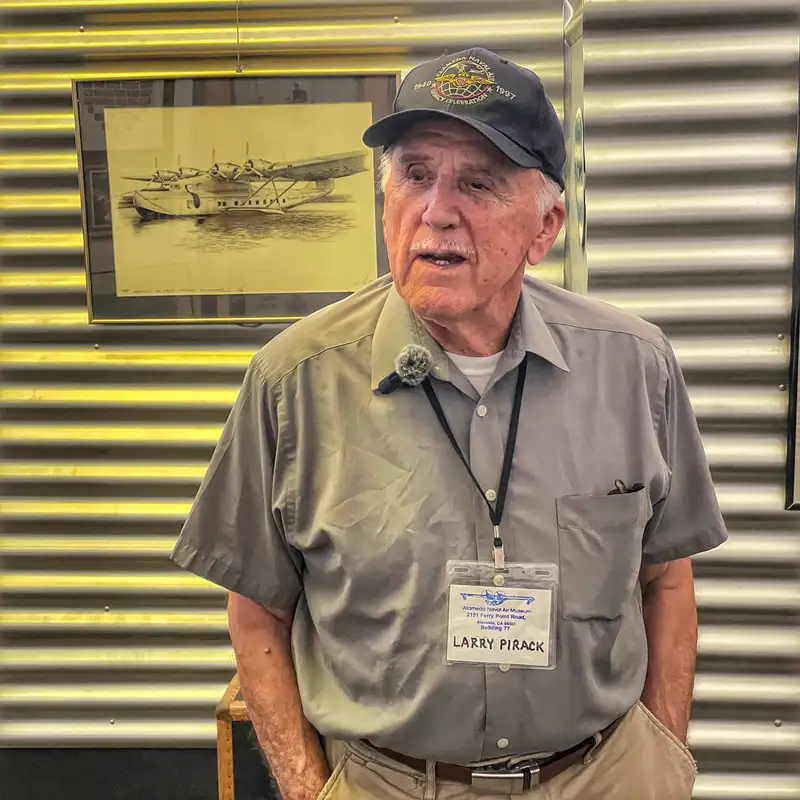
Hello Alameda! This is the Island City Beat and I'm Laura Thomas and I'm at the Alameda Naval Air Museum with the President, Larry Pyrek. Hello, Larry.
Larry Pyrek:Hi. Hi.
Larry Pyrek:I'm very glad to do this for the people that have worked so hard creating this museum. And this area in here, actually everything in here depicts what happened before the Navy came to Alameda to open a new base in 1940
Laura Thomas:and we are in the Pan Am Clipper Room.
Larry Pyrek:The Pan Am Room. And 1935 is when Pan Am first flew to China from Alameda. San Francisco Bay was the national airport, the landing area and the takeoff area for Pan American Airways, but the base was Alameda.
Laura Thomas:I thought it was also Treasure Island, weren't they on Treasure Island?
Larry Pyrek:That came years later when the just before World War II when Pan Am changed to Treasure Island in 1939 just before the World's Fair. So during the World's Fair, you could actually go up in a in a clipper, a short ride around the bay. I think someone told me that the cost was $3 for a fifteen, twenty minute air ride around the bay during the Pan American Exposition Exposition that took place, 1939.
Laura Thomas:Right, right. In our family, we have memorabilia from it.
Larry Pyrek:Well we actually have
Larry Pyrek:a little film too that we show.
Laura Thomas:Oh, do? So this building was the terminal, was it built by Pan Am?
Larry Pyrek:No, this building actually didn't exist.
Laura Thomas:Oh, okay.
Larry Pyrek:The terminal for Pan Am was at the very tip of the landmass of Alameda. The last piece of land of Alameda you see was where the Pan Am Lagoon was and there is nothing left of that that actual area other than the land, there's no buildings there anymore, but there was a very tip of Alameda where we are now did not exist. This was just marsh, marshland.
Laura Thomas:Right, right. So, so what is the early history of this building? When was it built?
Larry Pyrek:The building actually became used by the Navy in 1942. They were in a process of creating a new base and it opened in '40 and this was one of the buildings that was built in 1942. It was used for many different parts of the Navy. Actually, was told it was a building that they worked on and repaired instruments. It became the air terminal somewhere after World War two.
Larry Pyrek:And, that's, that's the information that I've received from people who had worked here.
Laura Thomas:Okay. So this Pan Am Clipper Room is not about what happened here, but what happened on the base.
Larry Pyrek:That's
Laura Thomas:right. Another part of the base. And it's full of photos and the people involved. And I think you were telling me that something about this man over here. Who is he?
Laura Thomas:Oh, he was the navigator for Amelia Earhart.
Larry Pyrek:Yes. He, Ted Noonan was his name and he was Pan Am's best number one navigator, the best one that Pan Am had. He was so meticulous during the flight that he completely was they said he didn't have meals. He just was so intense making sure that he was navigating Pan Am's flying boats to get to the right place at the right time. Fed Fred Noonan's last flight was with Amelia Earhart who knows?
Laura Thomas:What
Laura Thomas:happened?
Larry Pyrek:They've never figured out entirely what happened other than she went down somewhere in the Pacific.
Laura Thomas:Okay. Well, it's a very interesting room. There's many models of the planes. As I've said, there's maps and you say you have, you show a video or
Larry Pyrek:a Yes, little we have approximately fourteen, fifteen minute film. Matter of fact, the only thing that we had pertaining to Pan Am was the film. Everything that you see in this room has been brought in. Nothing was here pertaining to Pan Am. The Navy did have that.
Laura Thomas:Oh my goodness.
Larry Pyrek:Yeah, it's
Laura Thomas:a big relief map looks like a blackboard.
Larry Pyrek:Yes, it's actually the Pacific Rim of the world. If you see the curvature, that is the world, the heart of the Pacific, and that was in the main Administration Building, so we commandeered that for our room here, it was in storage, and we took a few people over to where it was being stored and thought it should be here.
Laura Thomas:Was that on Treasure Island?
Larry Pyrek:No, this was here on the base.
Laura Thomas:No, mean where it was stored, Pan Am
Larry Pyrek:it was in
Larry Pyrek:one of the hangars.
Laura Thomas:Because it moved to Treasure Island, the terminal or the upgrade.
Larry Pyrek:Yes, the terminal moved to Treasure Island in 'thirty nine, but that belonged to the Navy. We put the route on that. It didn't have the route. And if you look at the, some of the areas that are described from Alameda to Honolulu to Midway to Wake Island, Guam, and then on to China, that was done by one of our artist friends.
Laura Thomas:So the Pan Am Clippers landed at every single one of those spots?
Larry Pyrek:They had to land, yes, they couldn't fly nonstop in those days of the early air travel. The longest leg was it took twenty two plus hours to get to Hawaii so you can imagine just the first leg oh my goodness was probably the most serious and maybe the most dangerous.
Laura Thomas:Really?
Larry Pyrek:Because if they had a storm or a headwind, the plane was probably able to fly at 150, maybe 160 miles an hour, which is not very fast in today's travel. But, so it had to put down in Hawaii. Twenty two hours, if it had a strong headwind at times, they had to return. May not make it because they could only carry.
Laura Thomas:But they
Laura Thomas:would run out of gas when they did to turn around?
Larry Pyrek:Well, if they were less than halfway there and they thought, we might not make it, they went
Laura Thomas:Got it.
Larry Pyrek:Not too many times that happened, but that did happen. But all these islands had accommodations for Pan Am passengers and they had to be created by the Pan Am company.
Laura Thomas:Exactly. So that's an interesting part of Alameda history that a lot of people don't know about. So it's all here in the Pan Am Clipper Room.
Larry Pyrek:Yes. You know, fortunately we had that, but our artist friend, Larry Wilson, who was a member of our museum also, quite an artist, but he created that route from looking, studying the information that we had in some of our literature.
Laura Thomas:Man, marvelous. Okay, so built as an heir to, oh, I'm sorry.
Larry Pyrek:Alameda artist since passed away, but did a lot of good things for us, worked with children too here. So we're very happy to have any of his artwork.
Laura Thomas:Well, let's move into this big open area here, which I think is, might be the heart of the Naval history part. Would you say is that am I accurate?
Larry Pyrek:Yeah, we're kind of continuing on with some of the history of what took place here. The Navy had flying boats. They had a number of them and this display here is is probably the the most informative of what the type of planes they flew the models inside here they go from one of the smallest planes which was called a PBY to one of the largest or the largest planes the Martin four engine flying boat, and they were called Mars.
Laura Thomas:Mars. Uh-huh.
Larry Pyrek:The Martin Mars. By the way, January of this year, that plane was here.
Laura Thomas:Really? That very one?
Larry Pyrek:When I say that plane, I'm describing the plane itself. It wasn't the Martin Mars. It was the Philippine Mars, which was the same plane. But imagine that plane being here in the water.
Laura Thomas:Really?
Larry Pyrek:Eighty years ago, it was here.
Laura Thomas:Where did it come from? Canada. Oh, really?
Larry Pyrek:Yeah. It took three tries to get here.
Laura Thomas:Oh my goodness.
Larry Pyrek:Because of weather, because of engine problems, but it's now, it'll never fly again. It's in Arizona at the Pima Air Museum.
Larry Pyrek:Interesting. But it was Did it fly to Arizona one
Larry Pyrek:last time? It flew within a 100 miles of where Pima is located because they had to land in a lake.
Larry Pyrek:It couldn't land in in on land. It was equipped only for water landing.
Laura Thomas:So what was the purpose of this plane? Was it a transport?
Larry Pyrek:Yes, it was it was a transport, it was created later in World War two and it was going to be used as a patrol bomber, but it ended up being a transport and it flew on for many, many years. Canada had the last three and I can't remember the name of the company, but they were specialists in putting out fires. It was a fire bomber. It became a fire bomber. It was painted red and white.
Laura Thomas:You mean it put out fires?
Larry Pyrek:They'd pick up water and put in and pick up the water and then drop it over the fire.
Laura Thomas:Oh my goodness.
Larry Pyrek:And that was the last one and it was outdated. It, imagine how old it was still flying and it made it all that way. Yeah, we saw it was just, it was thrill to
Laura Thomas:Well, sometimes those planes, I mean, they're indestructible, right? Yeah. Right?
Larry Pyrek:That's right. That's right. And then this area here is also dedicated to the women in the service and the women in industry and and what they did in World War two and today you know the pilots here that are shown in this large photo are the women that flew aircraft in World War two and probably some of the people today that are young and they didn't know that but that women actually flew for The United States in World War two but they had their own Air Force and
Laura Thomas:All the Women's Air Force service pilots?
Larry Pyrek:They were called WASPs. Yeah. They were created, they were they were actually commanded by women. They flew every plane a man flew, the men flew, only they flew them to move them from one place to the other, because they needed that. The men were off actually in the war zone and there were about a thousand women that actually flew bombers, fighters, transports and very important, there were only about a thousand of them.
Larry Pyrek:And today I don't know if any of them are alive.
Laura Thomas:My goodness. Well, that's a good question. Yes, because, you know,
Larry Pyrek:very famous women. We got to meet a few of them. There were five of them here years ago that proceeded to give a lecture. They were really, really wonderful women and they knew how to fly airplanes.
Laura Thomas:Yeah, this is very important. Over here there's photos. These are civilian workers over here.
Larry Pyrek:Yes, civilian and military. Have some photos of nurses, army nurses, Navy nurses. There's a pilot there and if they were qualified, actually, you know, it's kind of kind of rare to see some of the women doing what they did in that era. This lady here.
Laura Thomas:So this is World War II?
Larry Pyrek:World War II.
Laura Thomas:Oh my goodness. So you have
Larry Pyrek:here's a smaller picture there.
Laura Thomas:Yeah, and this shows women's shows African American women. It shows them as nurses. It shows them repairing the underside of a, some sort of an aircraft.
Larry Pyrek:Yes.
Laura Thomas:And, it's very, it's very interesting. There is so much memorabilia here.
Larry Pyrek:We kind of reserve this area for women, men and today. Right. Here's a Lieutenant Colonel that's flying today. We just received this uniform and put it on.
Laura Thomas:Yeah, on a
Larry Pyrek:and she's currently, I believe she's currently in the military as a Lieutenant her
Laura Thomas:last name is Chalice. In helicopters. Marisol Chalice.
Larry Pyrek:These are all original newsprints that we've been given. Yeah. Most everything you see has been brought in to this museum. Very little was left here by the Navy. Right.
Larry Pyrek:Pretty much an empty building when we
Laura Thomas:Yeah. Took it You were telling me that the Navy, well, when the Navy left in 1997, there were a couple of women who really wanted to save it.
Larry Pyrek:Two founders, Marilyn York and Barbara Bach, they're the reason the buildings here to this day, they went to Washington DC and got funding and their background was Maryland was a wave in 1942 which was a Navy term for women at that time in the Navy that that term doesn't exist anymore the women have the same ratings and the same information on their caps in their their uniform that the men do women accepted for emergency service was the the wave it was Marilyn was in 1942 she was in the class first class of Navy waves here and Barbara worked here and they became friends and when they both retired they wanted to do something to save the history here's a newspaper article about Amelia Earhart that's an original article
Laura Thomas:that's a Herald Examiner would that have been in Los Angeles or Chicago it says Chicago Herald Examiner
Larry Pyrek:they're looking for and up here on the top of this counter case is more information about a mediator heart. Oh yeah. This print, a poster was the woman that recreated the flight. Oh, many years later.
Laura Thomas:1997, Linda Finch.
Larry Pyrek:Yes, Linda Finch. And she flew around the world. But she had she had support. She wasn't just a lone pilot in the plane. Believe that there was another plane also that was following her.
Larry Pyrek:Making sure. But she was flying the similar type of plane, very similar to the plane that Amelia Hart flew.
Laura Thomas:Goodness. Okay. Well, maybe we can go over to the civilian part over here. I remember that part. We can talk about that a little bit.
Laura Thomas:Because after the Navy or once the war was over, this the Naval Air Station shifted from wartime. Well, it was still focused on war.
Larry Pyrek:Right. Unfortunately, wars were continuing on and the base was a very important Navy base from that time through the Korean War through Vietnam Desert Storm. The many many employees and military personnel that were needed came in through this base to go to another base. The flights you can go anywhere in the world from this base if you were military or dependent or government.
Laura Thomas:Is that so? Yeah, you know, I think I heard, I've met people throughout my life who said, I was in Alameda, but I was on my way somewhere
Larry Pyrek:in transit somewhere. Yeah, They had they had billeted areas where personnel could stay overnight. They could even stay longer than that if they had some business here in the Bay Area, but yeah a lot of many many people came through this building not counting just the employees. By the way, the employees that were here when the base was created are in that photo.
Laura Thomas:Okay, so that would have
Laura Thomas:been in earlier before the war then.
Larry Pyrek:This was after World War II.
Laura Thomas:Oh, after.
Larry Pyrek:Okay. This was more in the fifties. There is a date, I don't see it here, we think that that photo was probably taken in the early 50s and the base opened in '40 and when it opened these employees were
Laura Thomas:all of those people were there. Yeah, it was about I'd say almost a 100 people, maybe 70 or 80.
Larry Pyrek:Probably, yeah, 50 to 65, 70 people. Some of the names that are on that list, there are still names that are here in Alameda.
Laura Thomas:See, that's what's so important about your museum is that it's the story of very many people who lived and worked in Alameda from the thirties until, you know, 1990 and Right.
Larry Pyrek:The 1940 was when the base first became an operated base by employees and naval and army personnel, Marines, they all came through this base for one reason or another.
Laura Thomas:Yeah, so you have pictures then of you have a whole couple of cases with
Larry Pyrek:That's right. There's some of the equipment that they could rebuild or create. They could just about create any piece of engine. They had a foundry machine shop, electrical specialists in that time that could repair things. The only thing I believe only part of a aircraft they couldn't build from scratch was an instrument, but they could repair it.
Larry Pyrek:But everything else they could machine, they could create, it was just a complete
Laura Thomas:A
Laura Thomas:lot of very skilled people.
Larry Pyrek:Yes, A lot of very skilled people.
Laura Thomas:And a lot of people in those days actually lived in Alameda, right?
Larry Pyrek:Yeah. Most everyone was well in the Bay Area within a
Laura Thomas:Well, how many employees at the height
Larry Pyrek:of operation? They estimated between military and base employees twenty four hours a day around 40,000.
Laura Thomas:40,000?
Larry Pyrek:It was a city, if you counted everyone that came through this space in a twenty four hour Well,
Laura Thomas:that's still, that seems remarkable to me.
Larry Pyrek:Yeah, it is. It was half of the city practically. You know, I think the population right now is close to 80, but in those in that period it might have been around maybe a population around 60.
Laura Thomas:Right. No, let's see. I came to Alameda in '83. The base was open and happening. And I'm pretty sure Alameda had at the most 70 or 75,000 in the early eighties.
Laura Thomas:So no, and the, yeah. And people say, oh, when the bay, you know, when the traffic, everybody leaving the base, it, yeah, it was a little, it was a little heavy, but Yeah. You
Larry Pyrek:Going through the tube was pretty impacted and it still is as of today.
Laura Thomas:Right. But there's a lot of, for anybody interested who has relatives or anything who worked at the base, there's a lot of interesting stuff in this little alcove.
Larry Pyrek:Well, we have a library that has some of the base history and also employees in books that were annually or semi annually printed and just full of people, individuals, Navy and Marine and civilians.
Laura Thomas:So it would be a good resource for people doing genealogical research.
Larry Pyrek:We have a library upstairs on the 3rd Floor that, people can come in and do research and, we, allow that anytime we're open and we actually open on Wednesdays for research we're not getting the word out like we should though but students people that are military historians if they want to check something we have a lot of information and some of our volunteers have put together a pretty good little library up there to do research. They don't check out the books, but they can sit down and spend time there.
Laura Thomas:Oh, wow. Okay. So
Larry Pyrek:Well, this room here belonged to Marilyn York, who was one of the two founders. Marilyn would actually would not sit in this room while we were open. She wanted to be outside at the entrance greeting people. We would ask her to come into the room and you could talk to someone if you'd like in a in privacy but now, she wanted to tell people about her experiences and this is what Marilyn looked like. This is how we knew her.
Laura Thomas:Yeah.
Larry Pyrek:From that photo till the time she passed away and Marilyn was just a a grandmother.
Laura Thomas:Well over 70 when she began this. Right? No.
Larry Pyrek:Well
Laura Thomas:Oh, yes. She was. She would've 1922. Oh, no. 50.
Larry Pyrek:Yeah. She was Alright. 90 plus there when she passed away, and it's been a while now.
Laura Thomas:Oh, this is the picture I'm thinking of right here in the engine accessories branch.
Larry Pyrek:That's
Laura Thomas:right. That's where she is.
Larry Pyrek:And that book was I mean, that picture was in a book in '74.
Laura Thomas:Mhmm. But it's taken in 1954, and she's the only woman amongst all those other male mechanics.
Larry Pyrek:So
Laura Thomas:that's pretty she was a groundbreaker in terms of civilian work.
Larry Pyrek:There she is there standing and then the other two pictures below that are her and her friend Barbara Barbara was in public relations she did photos, she took these photos of President Kennedy, and this one here, which I can move this over a little bit, maybe give you more room, That's when he attended the University of California at a graduation ceremony. He flew in, and he's in that Lincoln convertible there when he got out of Air Force One and
Laura Thomas:So she had real press credentials then.
Larry Pyrek:Yes.
Laura Thomas:That's a very interesting room that shows the lives of these two women that have started the museum.
Larry Pyrek:This was created after she passed. She never married. She was engaged. Her fiance was a Navy sailor, and he was lost at sea.
Laura Thomas:Oh, how sad.
Larry Pyrek:But these are all her quotations.
Laura Thomas:Yeah, she wanted to get out of Santa Cruz where my best option was becoming a five and dime clerk. So actually for women getting into the service at the at the war was sort of an opportunity to broaden their their horizons.
Larry Pyrek:Yes. But and again, this this we I can hear her say these very words as I'm describing her. And it's just she had a good sense of humor.
Laura Thomas:I
Laura Thomas:joined the Navy to see the world, and they sent me 68 miles away
Larry Pyrek:Yes.
Laura Thomas:To Alameda.
Larry Pyrek:Yeah. That was Maryland.
Laura Thomas:Okay. We're in the ready room and Larry's going to tell us all about it.
Larry Pyrek:Well, this depicts the area where the pilots and crews would get their training on board a ship in most cases and they would have planes model planes hanging from the ceiling so that they could study them because they wanted them to be able to tell whether it was a friend or foe flying at them at three or 400 miles an hour so that's what we've got here we've got a few of them hanging they were made out of a special heavy material if they fell and on the ground they'd shatter they were composite like material that was very heavy, they were molded and they all had holes in them. For some reason in this room because I think it's because of the temperature because we actually walked into a room that has a different temperature and it's all concrete the floors and the walls are concrete the ceiling everything's concrete and I believe it's because it's over the safe how below us but if you look at the wings the wingspan look at the wings on these planes.
Laura Thomas:Right.
Larry Pyrek:I can't tell you why it's doing that.
Laura Thomas:Yeah, they're tilted upwards at the tips or downwards and it's very strange.
Larry Pyrek:I think it's whatever atmosphere this plane. Yeah, for some reason. Yeah. And they're very heavy. I mean, they're not like made out of wood.
Larry Pyrek:It's a heavy material. They can't help but look up.
Laura Thomas:Right.
Larry Pyrek:But they're they're just even the fuselage on this plane is starting to To droop. Yeah.
Laura Thomas:Yeah. Right.
Larry Pyrek:Yeah.
Laura Thomas:Wow.
Larry Pyrek:So this, yeah, this is a room that we use for films, historical People can come in and sit down and watch film about a battle or.
Laura Thomas:Do you have a schedule or do you do
Larry Pyrek:you just request? We usually put the film on that goes with the date.
Laura Thomas:Oh, okay.
Larry Pyrek:Of either a battle or something in history and and war. We have a lot of film that was given to us. Mostly in in cassette form or disc form. But we can usually find something around the date that we're remembering.
Laura Thomas:My goodness.
Larry Pyrek:That photo up there that you're looking at is something that was going to happen. Oh. Unfortunately, it didn't. We're in the building on the far left and you see a walkway out of glass that went through the building
Laura Thomas:it's a plan for the Nalameda Naval Air and Western Aerospace Museum with an architect that would have been addition
Larry Pyrek:that would have been the Oakland Aviation Museum out at Oakland Airport there was a proposed merger that we were going to do with them this goes way back probably even before I got involved but it didn't happen. We had that hangar, the Naval Air Station Museum had the hangar but to support a building like that.
Laura Thomas:The hangar behind us. Yeah.
Larry Pyrek:Yeah. That was that was part of the deal with the Navy. And but it it never happened because the the money involved just wasn't there.
Laura Thomas:Mhmm.
Larry Pyrek:To do the moving. To do the construction. We are struggling right now with our insurance because it's it's actually four times what we were paying a year.
Laura Thomas:Yeah. Well, you want to should we talk about that?
Larry Pyrek:Well, when our insurance was canceled about six months ago, it was a surprise and we had to close because we couldn't find an insurance company that would take us so one of our volunteers searched and searched and searched and she's a lifelong Alameda very involved with trying to keep us alive her father worked here forty plus years yeah she made a promise
Laura Thomas:what's her name
Larry Pyrek:Julie Pond
Laura Thomas:Julie Pond okay
Larry Pyrek:very involved with different organizations and she was following her father's request you've got to keep that museum going because he knew something was afoot, things were getting worse. So she searched for a long time, went through 18 different insurance companies and they all turned us down
Laura Thomas:because it's an old building
Larry Pyrek:it's an old building it's solidly built with concrete the 3rd Floor is not 3rd Floor where we have the model train exhibit is made out of wood the Navy added that so the insurance went from 11 to 12,000 a year to 38,000 It just almost four times. Actually, actually more than four times. But anyhow, it so we're struggling right now. We did have a fundraiser that helped a lot. But we're about halfway there, but that's only going to cover a year if we make it.
Larry Pyrek:If we get $38,000 we're Yeah. Good for a So we're still under the gun.
Laura Thomas:So can you explain to us the relationship you have with the city?
Larry Pyrek:They wanna help us, but we keep hearing that they don't have the funding. It's their building.
Laura Thomas:So they yeah, because it's part of the base. We
Larry Pyrek:don't own the building
Laura Thomas:turnover or whatever you call it.
Larry Pyrek:Yeah, we don't own the building. The build building is owned. Everything inside of the building is the museums but we don't own the building and that presents a problem too lease wise we had a five year lease at one time and we can't get a lease right now because but we're still under the gun with that insurance so yeah we're treading water really we're treading water we can't say that we're going to be here permanently and yet you've been here since we've been here twenty going on twenty two years
Laura Thomas:so since 09/20/2004
Larry Pyrek:yes when we first opened the two ladies themselves got the funding to make the building usable because it sat for a while you know when buildings sit with no one in it they deteriorate things happen the leaks start and then vacant buildings are not in perfect shape when someone takes them over after many years.
Laura Thomas:Well this building has a wonderful location right off Seaplane Lagoon with a fabulous view of San Francisco and
Larry Pyrek:we couldn't say that would be another building on the base that has what this has for us this funding that we just did this fundraiser that we just did has helped us and it's just donations we're nonprofit so anything that comes in is a tax deductible donation and that funding brought in almost half what they would do if someone was interested in helping in the museum is up you send a check or whatever they might have to the Alameda Naval Air Museum with our address and we would acknowledge them with a thank you and we're non profit so there is a tax deductible
Laura Thomas:yeah And you also want to encourage visitors.
Larry Pyrek:Oh, yes.
Laura Thomas:Don't think enough people know about you.
Larry Pyrek:Well, yeah, we were right across from the Hornet. Some people know about both of our museums, but the Hornet is a bigger display, you know, that's a ship and but we're the history of the base here. The Hornet is a ship with a lot of really good history on it, but we're the history of the base before it was created Pan Am was part of that too. What are your hours? Our hours are ten to four on Saturday, we just reopened on Sunday, the pandemic caused us to close Sundays but Sundays is not a good day it doesn't appear to be doing very well we have very few customers come in on Sunday seems like we're the last stop if people come down to this area with all the nice restaurants and places to relax and the views to see it seems like around three to 03:30 when they're almost ready to go home they stop by and we're about ready to close
Laura Thomas:Well, you should adjust your hours.
Larry Pyrek:I know, I thought about that.
Laura Thomas:Twelve to five.
Larry Pyrek:That's the point.
Laura Thomas:What would you say to the general public or maybe to Alamedans, let's say, because we're an Alameda podcast. Why should they come and visit your museum?
Larry Pyrek:Well, I think everyone that lives in Alameda would like to know more about the history, even the newbies, the people that come in and haven't been in Alameda as long as I have or some of my friends they they are here for a nice place to live and maybe they've got a good job and this was what they want to bring their children up I would say this part of Alameda has so much history, so much history if you're a military historian, it's great, but you know you don't get that many younger people that want to come in. We do have some classes that come in private schools, but very few of the public schools have excursions down this area.
Laura Thomas:Well, what do you say to them? I mean, why is it important that they come?
Larry Pyrek:Mainly just to know you're living in a very historical area.
Laura Thomas:Yeah.
Larry Pyrek:And so many people don't realize that. So many things took place here when you think about aviation. Early days of aviation was Alameda. You know, there were three airfields here before the Navy.
Laura Thomas:Yeah.
Larry Pyrek:So much, know, there
Laura Thomas:was So many, but for me, so many people who lived, like I said earlier, have passed through Alameda, passed through here because the Navy, the Naval Air Station was, well, there's a lot in this museum. And I, for one thing, people should come and come and you never know what you're going to find around any corner in this place. It's packed with models, it's packed with photos, it's packed with newspaper renderings, it's packed with machinery. It's yeah.
Larry Pyrek:Well you know some people say, especially people who are trying to help us, they're trying to like anything to give us suggestions they say you've got too much, you should just represent the Navy. I believe they're right in a sense but all the people that came through here in in years when this base was active were all branches of the service all the government Navy, Army, Marines, Coast Guard. We still have a Coast Guard base here. By the way, two of our members were in the Coast Guard. One's a retired captain.
Larry Pyrek:The other man who was a warrant officer just passed away about a year ago. But Alan Tubbs is he lives here on the base in one of the big whites, which was the officers. He he still works for the government, but hopefully he'll be
Laura Thomas:So how many people do you have volunteering or active here?
Larry Pyrek:When I when you say active, I would say 10. Now that doesn't sound like many, because you say 10 and maybe only two or three at any one time. We need more volunteers. Most of our volunteers are in an age group that is passing.
Laura Thomas:Right.
Larry Pyrek:80 is our average age. We just discussed that today in our boardroom down there. Yeah, so we need the younger generation.
Laura Thomas:Okay. Well, I think you've probably taken up enough of your time, but it's been very interesting to hear about the name Alameda Naval Air Museum. And we encourage everybody to come out and visit on a weekend because dedicated volunteers.
Larry Pyrek:I
Larry Pyrek:hope so. Yeah, I hope what I've been able to transfer from my memory to your memory is important that and if you could make people realize that we're here to preserve history we don't want to make we don't want to change history
Laura Thomas:right
Larry Pyrek:we want people to know the truth about history and that's what we're trying to do and that's what our founders said we want to preserve history the two ladies that I respected they were like grandmothers they just wanted you to know what took place and you should know this and that's the way they taught the history and so we're trying to follow in their footsteps.
Laura Thomas:That's perfect. Thank you, Larry.
Larry Pyrek:Oh, you're welcome.
Laura Thomas:So this is the Island City Beat and we're signing off. I'm Laura Thomas. I hope you've enjoyed this. Goodbye.