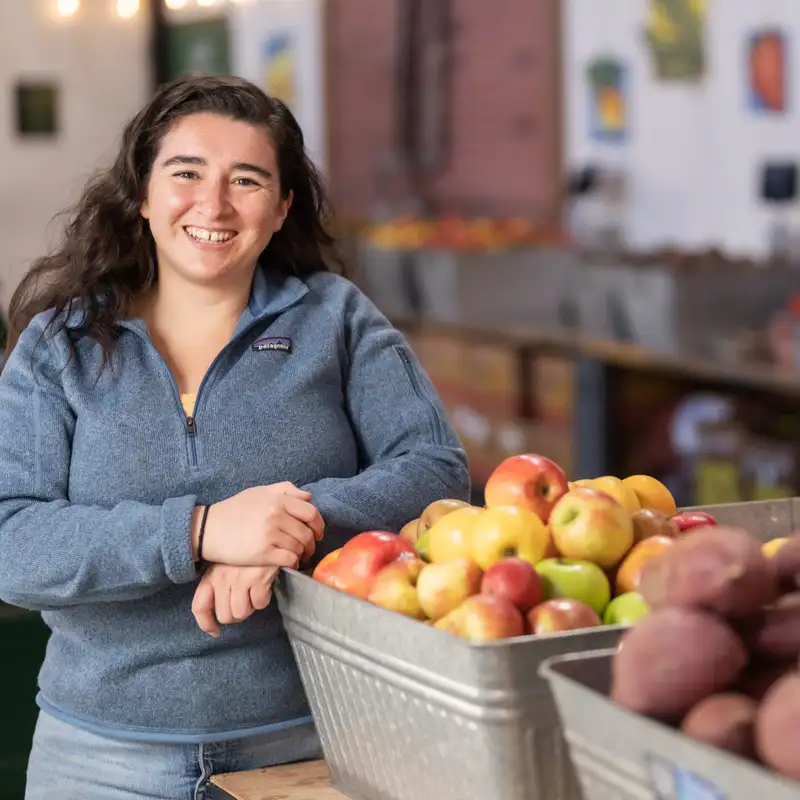
Hello Alameda. This is the Island City Beat, and I am Laura Thomas, host for today's episode. We're here at the Island Community Market on West Ranger Avenue. It's the new location and in some ways an enhanced facility and role for the old food bank. And we're going to hear all about it from Executive Director Teal Hardin.
Laura Thomas:Hi Teal.
Teale Hardin:Hi, thanks for having me.
Laura Thomas:Oh, we're excited. I'm so glad to finally be able to talk to you about this new facility and what a great service it is to Alameda's because you have been so busy. When did you move here?
Teale Hardin:We moved into this new facility in October 2025, so we've been here around six months now, which in some ways seems very short, in some ways seems like we've been here forever, But what I will say is that it's been such a drastic change in terms of our ability to provide food, you know, and meet our mission, food in a dignified respectful manner to our neighbors who are in need. So we're really happy to be in this space and to be able to, more fully realize that mission through this facility.
Laura Thomas:And right after the move or shortly around that time, there was the passage of the big beautiful bill, and then funding for SNAP benefits was threatened. Have things settled down at all?
Teale Hardin:Do things ever settle down these days? So when we first moved into this facility in October 2025, we had always had the intention when we were designing the space to be able to meet a greater need of crisis. During COVID, the food bank was very small, and we had stepped up to really become one of the largest food distribution organizations in Alameda County. So going through that process really made us realize as an organization that we wanted to be able to meet that need again in the future, and so we saw an opportunity in the design of this new space to factor that in. We never really thought that we would have to take action on on that crisis mode three weeks after we moved into this new space.
Teale Hardin:So we moved in in October. During that time, the government was partially shut down, and one of the barriers, one of the problems that was happening was that the SNAP program, also known as CalFresh here in California, people were not receiving their benefits, and there was a lot of uncertainty around when people would receive their benefits, if they would, how long that would take, and so there was a lot of uncertainty around where people were going to be able to access food. You know, SNAP and CalFresh is really a program that people rely on on a day to day basis to be able to access food for themselves and their families, and so not knowing where when they were going to be able to access those funds was stressful and detrimental to a lot of families. And so during that time, Alameda Food Bank made the decision to suspend our residency requirements. We normal normally only serve people who live, work, or go to school in the city of Alameda.
Teale Hardin:But during that time, we opened up to serving anyone who was in need. And so, again, the facility operated beautifully. We were able to have a very efficient distribution. We were busier than ever too.
Laura Thomas:Did you have to find more food, or was the food supply you relied upon adequate?
Teale Hardin:We sourced additional food through our partners. The community is also always great at stepping up, which is so incredible. So, during that time, again, we partnered with the Alameda County Community Food Bank who we partner with regularly, but we were able to try to source some extra food from them. There was also a county wide rapid response fund, we applied for some funds through that program. And, again just individuals who are so important to making our operations run and having that immediate response.
Teale Hardin:You know, the the county wide rapid response fund was great, but it's it's county. It takes a minute to get things going. And so having community members who stepped up and and really wanted to ensure that everybody stayed fed during that time was essential.
Laura Thomas:So at this point, can you give us a brief history of the food bank?
Teale Hardin:Yeah. Yeah. So the food bank began in 1977 and start we started operating out of a closet at Twin Towers, and it was really founded by concerned members of the congregation who knew that there were community members and neighbors who were struggling and needed help keeping themselves and their families fed better. So the food bank has gone through many different iterations over time, different styles of distribution, different locations. I joined the organization in 2019, and at that point, we were still operating out of the triple y trailer at the end of what is now Jean Sweeney Park.
Teale Hardin:And when I joined the organization, a busy day was serving about 60 shoppers, and we had a variety of different programs. People could shop at the trailer, people could shop at our warehouse, at a church, etc. There's different food available on different days, different locations, and as we know during COVID, the organization consolidated all of our programs and transitioned to a drive through distribution that took place out at our warehouse facility on West Ranger Avenue. So during that time, again, we had suspended all of our residency requirements. There was just such a great need across the entire Bay Area, so that was, again, a crisis response, and we were able to distribute a lot of food to a lot of people very efficiently.
Teale Hardin:But as time went on, we came to realize that a lot of food was being wasted, that people weren't getting the foods that they needed or could cook or fit their dietary or cultural needs, and so we really tried to be mindful of when as soon as it was safe for us to transition back to an in person shopping experience, that we wanted to do that. And we also took it as an opportunity to rework our programs and just kind of reset the clock, so to say, on how how we went about business and what kind of service we were trying to provide. So at that point, we developed Island Community Market 1.0 , we'll say.
Laura Thomas:Before the new facility?
Teale Hardin:Correct. Yeah. So coming out of COVID, we we created the Island Community Market 1.0 which was operated out of our warehouse at 650 West Ranger Avenue. And we did that for years until we transitioned over to our new facility in October 2025 with improvements, things that we learned in the old facility that worked, some things that didn't, some things that we couldn't change in that old facility because of the infrastructure that was existing. And coming into the new facility, we were really able to design around our program instead of trying to fit our program into an existing building.
Laura Thomas:You focus on serving Alamedans primarily, however. How do you determine eligibility?
Teale Hardin:We currently, under normal circumstances day to day, we are serving people who live, work, or attend school in the city of Alameda. So really people who are an active part of our community. And during those times of crisis, like I said, COVID, the SNAP benefits delay, that is when we suspend those qualification guidelines, and we'll open up to serving a broader geographic region. At that point, generally, it's anyone who's in need of assistance. That being said, if someone comes to Island Community Market and they don't meet our qualification guidelines currently, nobody goes away empty handed.
Teale Hardin:We have emergency food bags and referrals to other organizations. During our process, we do a annual certification process for shoppers. So when someone comes in for their first visit, we will verbally screen them and ask them to self report that they live, work, or go to school in the city of Alameda. That kinda gets people in the door. And then as they go through our check-in process, they'll eventually come to volunteers who will create an account for them in our our database.
Teale Hardin:And so at that point, we'll be asking for information. We'll be asking for things like photo IDs for anyone over the age of 18 in the household, mail for anyone over the age of 18 in the household, and at least one of those pieces of mail has to be dated within the past thirty days or so so we know that it's a current address. And then we'll also ask for something that just shows any children under the age of 18 are in the possession of, you know, the adults in that household. So that will be things like student IDs or birth certificates, insurance cards, things like that. And we ask that information not to be invasive.
Teale Hardin:We we try to approach it by asking as little information as possible, but we do have reporting guidelines, grants, for funding, and we do feel like this is a community organization. We really you say the phrase neighbors helping neighbors a lot, and we really wanna embody that. And so part of this is making sure that people are part of the Alameda community.
Laura Thomas:You have told us that you serve 12% of Alameda's population. It's startling to realize how many Alamedans need help getting the food on the table. You once said the proportion of people coming to the food bank went up with COVID. Do you see the cost of food jumping in the future with the destabilization of oil prices and how are you preparing for it?
Teale Hardin:Yeah, it's kind of challenging to constantly be in preparation mode. It seems like every other month, there is something new that we're kind of preparing for. And so whether that's, you know, even outside of what we experienced last October in terms of SNAP benefits being delayed, now there are changes to the SNAP program completely that are impacting who's eligible for that program. So we're anticipating a greater need as people don't have those benefits to rely on anymore. Can add that into, you know, food production costs, transportation costs, fertilizer and fuel costs, it's definitely a lot to factor in to try to plan for.
Teale Hardin:We we are in constant conversation with our partners at Alameda County Community Food Bank trying to figure out what is happening from their end. They have resources that are not available to us through the Feeding America network, through, you know, the county, etcetera. And so what they're doing to advocate to ensure that there are resources available to organizations like us and ultimately the families that we serve.
Laura Thomas:What is what is your relationship with the Alameda County Community Food Bank?
Teale Hardin:Sure. Alameda County Food Bank, we we have very similar names. So there's the Alameda County Community Food Bank, and then there's Alameda Food Bank, which is us. So both organizations and both types of organizations are very important. So Alameda County Community Food Bank, they're they do very little direct to family, direct to individual food distribution.
Teale Hardin:Their main goal is to work with their network of agencies. They have over 400 agency networks throughout the county. So they work with those organizations and provide food and resources who then go and distribute the food into their communities that they're integrated in. So it is essential to have both because, again, the County Food Bank provides us so much. About 50% of the food that we we receive comes from the Alameda County Community Food Bank, as well as, again, that connection and that county wide kind of response and look at food security.
Teale Hardin:The food that comes from the county food bank is going to be hand items, so it might be we're one of their largest food distribution organizations. We generally distribute number one in terms of how many pounds of food we distribute, and then in the top three in terms of number of visits that we administer. So the organizations are very, very varied. So there are large organizations like us, and then a lot of the other network agencies, they might be churches that do a once a month distribution, or it might be a school that has an on-site pantry, etcetera. So for us, we are generally getting pallets of items, whereas they might be getting boxes of items.
Teale Hardin:So for us, we would be getting we get two deliveries a week, and that is, again, generally pallets on a semi truck. And so we'll get, you know, a variety of shelf stable items, that'll be cans or bags of rice and beans, you know, oatmeal, milk, things like that. We also get fresh produce from them as well as sometimes bread, and then oftentimes protein items, either eggs or frozen meats, things like that.
Laura Thomas:How much food do you purchase yourself? About 50%?
Teale Hardin:Not quite. So it's about 50% Alameda County Community Food Bank, and then another probably 30%, I believe, we purchase. And so that's coming from a wholesale produce suppliers. Mostly what we are purchasing is fresh produce three times a week. And then in addition to that, we'll supplement any dry goods or protein items that we're not able to source consistently or for running on low inventory from what we're getting from the county food bank.
Teale Hardin:So an example of that might be, you know, eggs are one of our most popular protein items, and sometimes they're hard to get. I love the story about our new facility. One of the key components of this new space that is really incredibly helpful is our new walk in cooler. So our warehouse manager was able to get in contact with an egg supplier. They had too many eggs, didn't know where to send them, and so they were selling them for 63¢ a dozen.
Teale Hardin:But you had to buy six pallets at a minimum. In our old space, we wouldn't have been able to capitalize on that incredibly inexpensive protein that's popular across many different cultures. With in our new space, not only were we able to purchase and distribute those eggs, we're also able to partner with other organizations in the county. So two others across Alameda County that we were able to purchase and receive the eggs, and then they were able to come and pick up one pallet a piece. So more people across the county were able to benefit from that.
Laura Thomas:Sounds like there is a good county structure for distributing food resources.
Teale Hardin:Yes. Yeah. There is a structure for distributing food and there's I say this about the city of Alameda and I say it about the county. I think that there is something that makes this area so special is the amount of collaboration between organizations and cross referrals and trying to partner. So grateful for those other organizations where, again, in this egg situation, you were able to kind of act as a food hub to be able to accept and receive these six pallets of eggs that otherwise all of our organizations would have had to miss out on.
Teale Hardin:We wouldn't have been able to have the opportunity to distribute those to to our neighbors.
Laura Thomas:You told us that the Monday after Christmas, you had 982 people come to shop. Have you beat that record since?
Teale Hardin:I think that was still our record. So just just under a thousand, which is no small feat as anyone who has worked in food distribution before knows. It's also quote unquote normal Wednesday here is hovering over 700 families in a single day.
Laura Thomas:Again, these are people who mostly live in Alameda.
Teale Hardin:Correct. Yep. Almost entirely live in Alameda. Like less than 5% of our visits come from people who are working or going to school.
Laura Thomas:You now call the food bank, the Island Community Market, and it operates as a free grocery store on what you call the client choice model. Can you explain how it functions?
Teale Hardin:Sure. So client choice model is kind of a broad term that many food banks and food pantries use, and it's basically it's any sort of distribution where a shopper, someone who's receiving food, is able to come in and choose their food to some extent. That doesn't happen. So for example, with COVID during a drive through distribution, there was zero choice. We were pre packing bags of produce, pre packing bags of dry goods, throwing some sort of protein into a bag and putting that on someone's vehicle.
Teale Hardin:In that situation, you know, somebody who was Halal may have gotten food, meats, particularly, who they wouldn't have been able to consume them.
Laura Thomas:That would be a waste.
Teale Hardin:A waste. Exactly. Which is why we were so adamant to try to get to a in person shopping experience as quickly as possible.
Teale Hardin:So with the client choice model, like I said, it's a huge continuum where it can be everything from kind of a farmer's market style where there is food in boxes out on a table and shoppers go down a line, there's a predetermined pathway, and it can be either volunteers handing food to people or a slightly more progressive version would be shoppers being able to pick the foods themselves, pick up not only making the decision that I want apples today, but I want this apple, shoppers making the decision that they want this apple, not that apple, and and being able to have that level of choice. So there's the farmer's market style. We're kind of on the per very progressive side of the client choice continuum where, really, once a shopper gets onto our shopping floor after they've gone through the check-in process, it's a very autonomous process. They get a shopping cart. They're able to go about and pick up all of the different items.
Teale Hardin:There are limits so that we make sure that we have enough inventory for the entire day, but there's no no one monitoring.
Laura Thomas:We put out a little sign.
Teale Hardin:Exactly. There's a limit sign.
Laura Thomas:Items can be pulled from this.
Teale Hardin:Yes. There's a limit sign at each station. So today, we have we should have always at least 12 fresh produce options, and so it might be that someone can get six apples and two zucchini and one cabbage and three lemons based on the inventory, based the quality of the food, how busy we think we're going to be, do we have a holiday coming up, etcetera. And then once shoppers are done going through again, it's just very try to normalize it as as close to a grocery store experience as possible. Then they go through a checkout process and everything is free.
Teale Hardin:But what we're doing is our our volunteers are checking to make sure that shoppers are following the limits for the most part.
Laura Thomas:So when they come in, how does it work? Do they have an appointment? You said it runs like the DMV.
Teale Hardin:Correct. Yeah. So with food banks, something that is a common occurrence is that people coming to access food will sometimes arrive super, super early. They'll be waiting outside for two hours in the rain, whatever the weather is, and there's a perception around food banks often that the best food is only available in the morning, that we're going to run out of food, that you'll get the leftovers at the end of the day, that it's worse quality if you come later in the afternoon. So all of that feeds into this theme that we see over and over again at different food banks of people coming very early.
Teale Hardin:And so this has been something that has been happening for very a long time .
Laura Thomas:Not ever having had to go to a food bank, a lot of these things have never occurred to me.
Teale Hardin:It's just these deeply ingrained ideas about what the experience is going to be like.
Teale Hardin:And so, again, in this new facility and even prior to this, we really tried to identify, like, where are these pain points and especially, like, human conflict, where if someone is, you know, visiting a food bank, maybe it's a high stress situation, maybe they're uncomfortable being here. There were times where there was interpersonal conflict when people were waiting in line, and so it is always a goal for us to try to disperse that line as quickly as possible or make it not happen at all because, one, it's not dignified. People don't, you know, go go out to the grocery store and wait in line for a grocery store to open, but because of the perceptions we have around food banks, people do that. But then in order to do that, it's really just how do you come up with a process that is going to be helpful for managing a group of people? And so what we did is we started offering appointments, which we previously have not done prior to the pandemic.
Teale Hardin:So by offering appointments, it gave and we we give priority to people who make appointments. So by offering an appointment and giving them priority in service, then it increases incentive for people to come later in the day because they're going to be served more quickly. So instead of having 50 people in line at the beginning of the day, if we can get five, ten, 15 people to book appointments for later through the day so that they'll be served quickly, then that reduces how many people are in line.
Laura Thomas:Is that working?
Teale Hardin:It works for the most part.
Teale Hardin:The people who still come and line up in the morning, you know, there again, there can be interpersonal conflict. So at a certain point, we went out and had just conversations. Okay. I'm making a lot of assumptions about why people are coming to stand in this line in the first place. Let me just go out and ask.
Teale Hardin:So I went and had conversations with some of our shoppers, many of whom are regular shoppers. They're people who come every week or nearly every week. And what I found out was that people, one, it's mostly older adults who are coming and so people who are up early. Two, that they really did not wanna be out during the middle of the day when it was warm, and so they really wanted to get their shopping done early in the day so that they could get home and and have the rest of their day for themselves and not be affected by the heat. And then three, there was a social aspect.
Teale Hardin:People come in groups with their friends and then they go for a walk. So by having that conversation I was surprised and it also completely changed my perception of this group of, like, I had been viewing it as this somewhat negative experience. Yeah. And it really, I think, was a good reminder that you just have the conversation because you don't know what people's experiences or motivations are. So just just ask, like, that's the easiest way to find out.
Teale Hardin:So
Laura Thomas:Did some of those people change their minds about getting appointments?
Teale Hardin:Yeah. So some people have changed. We have definitely have less of a line since switching to an appointment process, so but not everyone. And again, I think some of the reasons why people are still coming during that time are the reasons that I just outlined of, like, the social aspect, and it's, like, really actually a positive experience. When people come in, we offer both appointments, and people can come in without an appointment.
Teale Hardin:The only difference is is that we offer appointments every thirty minutes, and we'll serve the appointments at the top of the thirty minute time slot. So it really just helps create a system for people to be served in an order. So when people come in, they'll stop at our reception desk, they'll get a they'll show their photo ID and a food bank card, and then that information gets entered into our system. It pops out a ticket with a number on it, and then very similar to the DMV, they'll go and have a seat in our waiting room until their number pops up on the monitor, and then they'll go over and they'll be checked in for their visit today, offered to book an appointment for their next visit. And then also if they need to either certify their account or if this is one of their first time then, but we'll get an account set up for them at that time.
Laura Thomas:So there is not a long wait?
Teale Hardin:Generally, no. I don't wanna say definitively no because as we know, you know, we're serving a thousand people in a single day, there's going to be a little bit of a wait. But what I will say is in this new space with this system that we have developed, it's it's pretty efficient. We're we're able to move through the queue of shoppers pretty, pretty quickly. And our shopping floor is larger than it was previously, which means that we can have more shoppers shopping at one time and also we'll get people turned over.
Laura Thomas:It sounds like you have totally destroyed any myth that the food bank runs out of food or has raggedy produce.
Teale Hardin:Exactly. A lot. Which also went into the design of the space in, all of our produce displays are on wheels, and they all, have these kind of shallow bin toppers. And so what we'll do is we're constantly bringing out new displays of produce. We all know we eat with our eyes first, and so when you go out and you see, you know, if the produce isn't looking that great, it's like, you know, even if the individual item is good, if the display doesn't look nice, you automatically kind of make assumptions about the quality of the food.
Teale Hardin:So by having these mobile displays, we'll do we'll restock them kind of in the back of the house, we'll take the empty display off of the shopping floor. We'll replace it with a new fresh display that was just prepared, and that also helps encourage people to know that if they come, you know, regardless of what time they come, they come at 10AM on a Monday or 06:30 on a Wednesday, that they're going to be getting a quality shopping experience.
Laura Thomas:Is there a limit to the number of items a shopper can have?
Teale Hardin:Correct. Yeah. Yeah. There there's limits for each item. So, again, for example, today, it's like take four zucchini and six apples and one cabbage and two cans of this bean and one bag of gnocchi or whatever it is.
Laura Thomas:And all of this operates with only six paid staff.
Teale Hardin:Well, has actually changed since the last time we talked. Yeah. We have been just serving so many more people more consistently. We have new and more programs that are happening. So we are we have a new program coordinator who will be starting in just a couple of weeks.
Teale Hardin:And so what that role is is, one, we'll support Island Community Market, which is our largest program, But then we also operate a number of other programs not inside this building. So that'll be we have snack program with Alameda Unified School District, community closets program that happens at a number of different schools, and that's in conjunction with All Good Living Foundation. And Alameda Unified School District, we do mobile pantries with Alameda Housing Authority at a number of different sites. So that program coordinator will be providing additional support to shoppers and our volunteers who make Island Community Market possible.
Laura Thomas:And you also have 800 volunteers that help you.
Teale Hardin:Yes. Which has gone up since 2024. In 2024, we had about 600. 2025, we have over 800. So, again, just the the community mindedness of this community is so impressive and really, again, not many organizations are doing this this style of food distribution, really operating a free grocery store, and part of that is because of the number of people that it takes to make this possible.
Teale Hardin:And so I think everyone who is part of the food bank community should be incredibly proud of having this as an asset, again, not only for our island, but to be able to kind of scale up during those times of crisis and and serve a broader set of needs.
Laura Thomas:Who funds all of these programs?
Teale Hardin:Yeah. I think the biggest threat that I see is, again, these changes to the SNAP program, CalFresh. So one which has already taken effect that happened on April 1 is changes to immigrants, how immigrants receive SNAP benefits, and that that many are not anymore, and that was effective immediately. The other one is changes to who is considered an able-bodied working adult. And if you are considered an able-bodied working adult, there are additional restrictions around if you can access that program.
Teale Hardin:So we're anticipating a substantial number of people who are going to no longer qualify for this program and are going to need to find other resources to fill in that gap.
Laura Thomas:Do you see a crisis coming?
Teale Hardin:I haven't heard anything substantial, but it is definitely part of the calculus around what what is a crisis and when do we think this is going to happen. And I think that it reinforces the essential nature of our interconnectedness with organizations and local community. Obviously, the price of fertilizer, the price of fuel are going to be major factors in any level of food access. We're lucky that there are so many farmers nearby that we we have the locality to be able to access food, but whether, you know, the prices are accessible. And as we continue to see food prices increase, are we going to then see more people coming to food pantries because of their food budget?
Laura Thomas:Have you heard reports perhaps that the cost of the high cost of fertilizer could cause food shortages?
Teale Hardin:You know, these SNAP changes, there's gonna be more people coming off the SNAP coming into food banks. Are food banks going to be able to source sufficient food due to transportation costs, fertilizer costs, fuel costs, food production costs, etcetera? And then in conjunction with that, are more people going to be in need of food banks and food pantries because of the cost of food rising and then creating this vicious feedback loop of not having enough resources at food distribution organizations and then more people coming in and then not having enough food. So it it it could be disastrous, but we're we're doing as much as we can. And, like I said, I think it just highlights how reliant we are on our local community and our local connections to be able to try to mitigate that as much as possible.
Laura Thomas:Is the fresh produce coming from local farmers?
Teale Hardin:We work with a wholesale produce supplier. So they work out of Jack London Square, and it comes from a variety of farmers. Sometimes it is local and sometimes it is, you know, local to California, but not necessarily as immediate. But something I'm very proud of is AFB has these super strong relationships with a number of farms here on the island, and so I see that as a huge opportunity, specifically for this situation that we're talking about is how do you improve the hyper local, you know, food supply.
Laura Thomas:What About a community garden?
Teale Hardin:I I think it's the support and the knowledge. So one of the farms that we work with is the the Reap Climate Center. So we provide a bunch of green waste to them that they then use for compost on the farm. And they've been around for years, the number of people that I talked to whose
Laura Thomas:What is it called?
Teale Hardin:REAP Climate Center.
Teale Hardin:Yeah. Yeah. And they people still aren't aware. There's there's people I could say I tell the story, people are there's farms in Alameda. It
Laura Thomas:It sounds like we have a good network for Alameda to build on.
Teale Hardin:Yep. Alameda Point Collaborative. There's the Maker Farm. There's a number. So, yeah, more more than people realize.
Teale Hardin:We love community gardens. We literally had Christ the Episcopal Church community garden in here this morning, and my god, the chard looks so beautiful.
Laura Thomas:At Island City Beat, one of our beliefs is that a strong food security system is going to be essential. If people want to get involved, what kind of volunteer work do you offer?
Teale Hardin:Volunteer work is very broad, but I also always like to say that you can be involved and you can be part of the food bank community without volunteering. So volunteering is a great way to get involved, and it really helps form the connection because you are generally working with the community who's also benefiting from your volunteerism. So most of our volunteer work does revolve around Island Community Market. So think about the things that would happen at a grocery store, and those are often tasks that are are happening. So it'll be things like restocking produce or dry goods, being part of our check-in process, going out and gathering the shopping carts from the parking lot.
Teale Hardin:Those are some of the the opportunities for on Monday, Wednesday, Fridays when we're running Island Community Market. In addition to that, we also have our Tuesday volunteer opportunities, and that is where we are doing we're packing our home delivery packages. So that's for individuals who don't have transportation or mobility or a social safety net to be able to pick up food on their behalf. So we have incredible volunteers who will come and pack those packages, but then other volunteers who pick them up and drive them around the island to deliver them to individuals. So those are some of the volunteer opportunities, and then there are always random ones throughout throughout the year.
Teale Hardin:In addition to that, we talk about, you know, community members being advocates. Anytime that we are can amplify what the food bank is doing, you know, the number of times that people I shared it. We're serving 12% of the population, and people are just aghast by that number. Sharing that sharing that there is even if it isn't always super visible, there is need in our community, and people who rely on the food bank to be able to meet their nutritional needs. Some of our most regular shoppers are older adults, people who have lived here for a very long time, fixed incomes, and and really rely on the food bank to be able to make their budget work for them.
Teale Hardin:It's it's a very large proportion. I won't say the majority, but it's very in large proportion and oftentimes the most consistent people who we're seeing every single week or close to. So so being an advocate, sharing, you know, a link to this podcast or a a social media post, talking about it with your community, kind of amplifying again the the work that we're doing, we think that's just as important.
Laura Thomas:I hope people will listen to our podcast and get a sense of what it's like here because it's not what I expected.
Teale Hardin:In what way? What were you expecting?
Laura Thomas:The old style where people came and received a box of food.
Teale Hardin:Which is often for many people. That's that that is the experience as people come come in, and they it's not what they expect. So on that note, we're always happy to do tours. We're always happy to set up times, you know, if your book club wanted to come in and do do a tour, we you're, again, so reliant on our community, and we really think of this as a community space. And we're we're always happy to do tours.
Teale Hardin:So even, you know, if someone's book club wanted to come in and take a tour, we would be happy to set that up. Again, we think of this as a community space, and so, you know, any community members who want to come in, we're always happy.
Laura Thomas:And what kind of donations do you accept?
Teale Hardin:We love food donations, and in general, we try to encourage people to make in kind donations of things that make food fun that help turn food into a meal. Again, because of our relationship with Alameda County Community Food Bank, we are pretty good at sourcing, you know, the staples, rice, beans, canned tuna, canned chicken, produce, things like that, but things that kind of make food special and can help turn it, like you said, into a meal. Global foods, spices, sauces, things like that are very, very popular and always well received. Again, because of our snack programs with schools, we love bulk packages of snacks that can then go out to kiddos at recess. And then I I always just have to make a plug that as much as we love donated food, financial support is always key.
Teale Hardin:It allows us to buy things in bulk that, you know, again, we'll use the egg as an example of the general public does not have the opportunity to buy eggs at 63¢ a carton, and so we do get those opportunities not only with eggs but with other shelf stable items. So financially supporting us makes sure that the organization is in a position where when those opportunities arrive, we can capitalize on them and, again, not only support our community members here on the island but throughout the Bay Area.
Laura Thomas:That's fantastic, Teal. At Island City Beat, we believe that a strong community can punch above its weight in this world, and it seems that's exactly what you're doing. It's a testament to the goodness that resides here in Alameda. May your mission expand and may we all continue to prosper because of it. This is Laura Thomas talking today with Teal Hardin of the Island Community Market, signing off until next time.
Laura Thomas:Thank you all for listening.