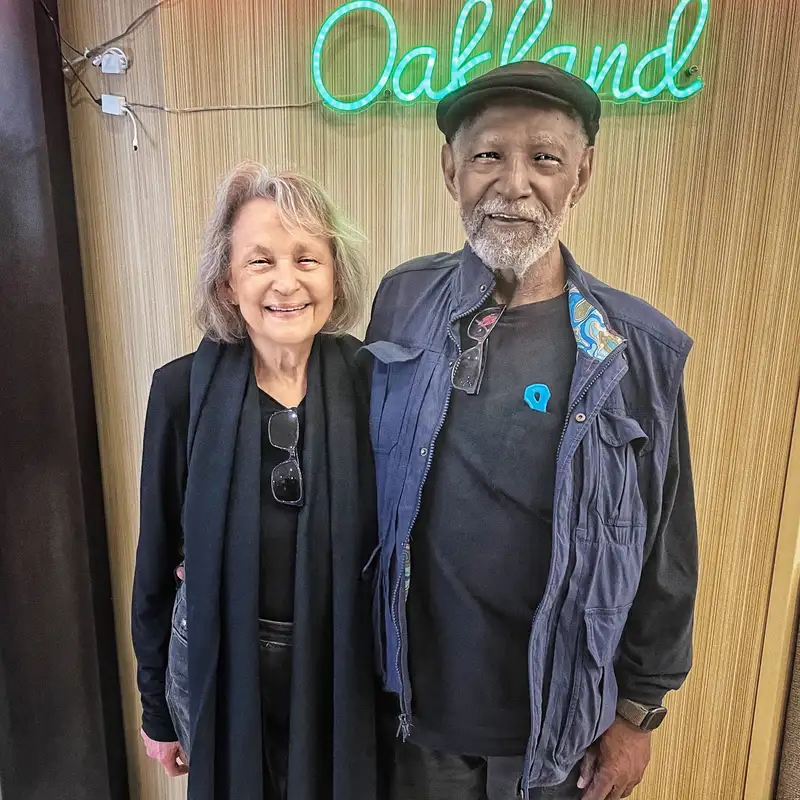
Hello Alameda, this is Laura Thomas talking to Jerome Scott and Walda Katz-Fishman again about their book, Motown and the Making of Working Class Revolutionaries. It tells the story of Black industrial workers in Detroit in the seventies who studied the capitalist system and analyzed how it consolidates control of profit foremost by using technology to eliminate the cost of labor. Where does that leave us? Those of us who rely on working for a living are made obsolete. What does it mean for humanity?
Laura Thomas:How are our needs going to be met if we cannot make a living? So Jerome and Walda, let's continue. I think many people get scared when they hear the word revolution and assume it means a violent and chaotic overthrow of the government. Yet even Greta Thunberg, the climate activist says the climate crisis cannot be solved without system change. So how how how do we start to view this system change?
Laura Thomas:What could some of its components be? And is there any room for reform?
Walda Katz-Fishman:So, you know, the word revolution is scary, but only scary in the twentieth and twenty first century, everybody is happy to talk about the American Revolution and the French Revolution and the Industrial Revolution. So, I mean, I think context is really important, but I just say that not in jest, but to just make us understand the moment we're in. Revolution means a qualitative, a fundamental change of the totality of whatever it is. And what we always talk about is we are in an objective technological revolution, whether we like it or not. So take a deep breath and, and accept that there are pieces of that change, particularly the technological revolution, that capital, the capitalists are driving that.
Walda Katz-Fishman:And it can help humanity if we are in control of it.
Laura Thomas:Very well put. Right. It can help if It's us who's in control.
Walda Katz-Fishman:It's who is in control.
Laura Thomas:Not what's happening, not the technology.
Walda Katz-Fishman:Right. And so I think a big piece of it is really the, the, the consciousness raising in the political education that we have to do with each other in our communities, wherever we are to say, you cannot hold history back. People have tried and tried to roll history backward. It does not work. So when we think about the change, we are going to have to change the question of who holds the levers of power, who holds the decision making decisions.
Laura Thomas:What is this change producing and for whom?
Walda Katz-Fishman:Right, right. We're going to have to change the way the economy is organized, markets do not work, people do not have money. And so if we have an abundance of food, of housing, I know you all out here in Bay Area, know
Laura Thomas:Housing is one of our biggest problems.
Walda Katz-Fishman:Right. And it's a question of distributing those based on our humanity and our human need rather than the ability to pay, because workers have lost the ability to purchase the housing and the food and the shelter. So, so the economy is fundamental, it's about reorganizing it as a cooperative system where we all contribute our our labor and we all receive the necessities that we need to be healthy and to also reclaim the planet. And only when you take the profit motive out of everything, whether it's the tech industry, the oil industry, whatever, only when we take out the need for a small class, the capitalists to make maximum profit are the broad majority of humanity, the seven plus billion people of us that inhabit this planet.
Laura Thomas:Yeah, I, I, you know, I of course agree with you. I, I think many people have a notion that, people are not ready to cooperate, that greed will take over. I have my arguments against that. I'm wondering how you would respond to that.
Jerome Scott:You had asked a question about reforms as well.. And I think that's important because on the question of revolution, you know, revolution besides the fact that it's been celebrated, like this is supposed to be the two hundred and fifty year anniversary of the revolution, you know, the signing of the, you know?
Laura Thomas:It is. That's right.
Jerome Scott:And and so they talk about revolution. I think more and more people are realizing that we're in the midst of one like Walter just said. You know, in anybody you talk to and you and you mentioned what's happening with the economy and and how technology is changing everything. And it's really a revolution from one way of producing the goods and services that we need to a whole different way, which means that it's going to eventually change the entire world. And that's what a revolution, you know, when you look at the at what it is,
Jerome Scott:it's really a transformation of one country at a time, but eventually the entire world.
Laura Thomas:And it is not, and there's plenty of violence already accompanying it.
Jerome Scott:All revolutions have started with the battle for reforms. So, battle for reforms still goes on, but when we look around here now and see what's happening, all the reforms that we have historically fought for are now being taken away.
Laura Thomas:Right.
Jerome Scott:You know, I mean, they've gutted the Civil Rights Act. They've taken away the right of women to bodily autonomy You know, which was there for fifty years. You know? And and so, yes, we have to keep fighting for these reforms. But these reforms have to be connected with the revolutionary process that are already going on. That only way we can secure and consolidate a reform is by transforming this society, you know, so that that reform is meaningful to the way that we organize the society.
Laura Thomas:Exactly. Okay. I, you know, I, I want to, bring up another point, which, I'd like you both to, both of the two of you to speak to, which is, a differentiation in terminology that some people get, caught up on. So in the study groups of the league that I've gone to, there's this very important differentiation made between the government and the state. So at the moment, the Trump regime is fixated upon dismantling our government departments while simultaneously reinforcing the repressive state apparatus.
Laura Thomas:Can you explain that the difference between government and state and why it's happening at the moment?
Walda Katz-Fishman:Okay, that is a really important question. And, we actually just had a conversation about that. The government is primarily folks who are elected. Right? They are elected by the people to quote unquote, serve the interests of the people, which many times they do not most times.
Walda Katz-Fishman:But, but it's these elected officials who are the head of the executive branch, the head of the legislative branch. And they then organize a whole series of institutions, you know, Department of Education, Department of Health and Human Services, so forth. The state is the entire apparatus of power. And it includes a very important component known as the military, the National Guard. It is those agencies of, of militarism and military power who really in the final analysis are acting to keep in check, to act in the interest of the ruling class, and to hold in check those of us who would challenge the existing power relations, or we would call them class relations, right?
Walda Katz-Fishman:Those who own the property in the world, and then, you know, the housing property and the other property, those of us who are trying to eek out a survival. So when we talk about the state, when I we think of it, it's a very powerful agent of both violence and control by definition.
Laura Thomas:Very interesting. Yeah. So I'm thinking of tactics here and, and I think maybe even wrapping up a bit. What, what is the next thing we should be doing? I was curious, you know, I did want to ask a question what the league back in the day would have thought about the whole notion of identity politics.
Laura Thomas:I, that always comes up with people that are critiquing progressives and critiquing liberals. And so what would the league have said about that.
Jerome Scott:Yeah. You know, this whole question of identity politics, usually it's brought up because people are fighting for the, you know, like in this country, mainly against white supremacy, you know, like the whole response to the George Floyd murder. You know, it was an experience. You know, when you look at the demonstrations, the thousands of people that rebelled against that, the vast majority were white. But they they centered in on the whole question of Black Lives Matter.
Jerome Scott:You know, as opposed to like if a Black life matter, then you mean the rest of the folks don't matter, which was nothing. So mainly the identity politics come along because they don't like the discussion of the realities of what capitalism makes this society about. Right. And it really gets to me, it gets to this question of whether it is the relationship between race and class, you know, and is class the dominant or is race the dominant? And I think that's a false equivalency because in this country, in The United States.
Jerome Scott:The whole struggle is expressed through both, you know, in the League of Revolutionary Black Workers, we understood and why we called ourselves black workers. We understood that the role that race played in the class dynamics of this society was very powerful and very profitable. You know, the fact that they could use white supremacy to pay black workers less meant that they were able to aid in their maximization of profit. So we realized that, no, I mean, it's not really identity politics if you understand relationship. You cannot fight for class without fighting also for race.
Laura Thomas:They are united.
Jerome Scott:They're united. The process is it's all part of the same process.
Laura Thomas:And that's probably the way we should. I think in many ways, people are beginning to understand that more and more.
Jerome Scott:Yeah, right. And that way, we prevent them from trying to use identity politics as a weapon against the struggle of making sure that you don't forget black workers and black people in this country is dealt with differently and continue to be dealt with differently. And we cannot ignore that in our struggle to understand the class relationships in this society as well.
Laura Thomas:I'm wondering, the the the strategy that, the brothers in Detroit used at the beginning of their struggle with wildcat strikes. So what kind of strikes should we be contemplating today? Are they certainly not gonna be limited the job site, are they?
Walda Katz-Fishman:So, you know, there's a lot of discussion. Well, I want to back up. In the very early days of the union movement, the union movement was not just representing the workers on the job site. The unions were really representing the broad working class in their communities, you know, their families and so on. And when Jerome talked earlier about the McCarthy period and the transformation that happened within the union movement, that was a point also with which that sense of unions representing the working class, not just the dues paying members of So, the want to just kind of put that context there.
Walda Katz-Fishman:A lot of discussion is taking place about organizing a general strike. I know folk in Oakland know that there was a historic general strike, which is really general in that it is a strike of all society against business as usual, whatever that activity is.
Laura Thomas:And they're similar to the strikes that happened in Europe at times.
Walda Katz-Fishman:Right, right. So, I would say that that is an important possibility that a lot of us are organizing around and leading up to it, the unions have been active in it, but so have social movement forces, folks that are organizing around No Kings, the Women's March and so forth are thinking about organizing a general strike. I think it's in '28, in 2028 when some major contracts are coming, you know, happening, but there's also much more discussion about having general strikes in major walkouts sooner. So I think this is all you asked earlier about, you know, what should we be doing now? It's this preparatory work to, to have us understand what is our, what is our commonality?
Walda Katz-Fishman:What are the common struggles we are fighting And, and also clarifying who is the enemy or what the enemy is.
Laura Thomas:Maybe we really have to do that. Yeah. Because many people are tending to still wonder if the democratic party is going to come in like the cavalry and save 'em.. and so..
Walda Katz-Fishman:History suggests that that is not going to happen, but we still need to engage, right? I mean, this point of engagement, you know, Jerome also spoke about the, you know, we fight the reform struggle. So, and then we, the revolution makes that possible. The engagement with the democratic party will help educate us about its limitations.
Walda Katz-Fishman:And what our responsibility as transformers, right? As transformative, visionary folk.
Laura Thomas:Do you think we need a new party or do we need more a working movement?
Walda Katz-Fishman:You go for party. Yes. The answer is yes.
Jerome Scott:Yes, I think we need a new party. I mean, it's proven that the Democratic Party and the Republican parties are parties of the ruling class. I mean, no matter how how we think of they they have a division of labor. You know, one concentrates on the businesses and the other one concentrates on the workers historically. But their tasks have been the same.
Jerome Scott:How do we how do we organize our party so they can act like it's representing our constituency, but at the same time protecting the system? You know, and so, yes, I think the the only way that working people are going to be represented in this struggle for a better level of our living standard is by developing a third party that represents that comes from the workers and represents the workers. You know. And and I think that's a real fundamental part of what we need to be doing right now. And things are moving in that direction.
Jerome Scott:I mean, we know that more people dislike and disassociate themselves from both of the parties. You know, they're not registered. You know, more people are not registered as a Republican or a Democrat than is. And that tells us that there's room and there's there's an indication that there's a need for a different kind of party that actually represents working people and the working class in general.
Walda Katz-Fishman:We need to find each other. So that means we have to be active. We have to be engaged and we have to be active. And we have to identify folk that have a certain recognition of the need to build something new so that we can create that transformative new society. And we need to have talked about the importance of organization.
Walda Katz-Fishman:I mean, if you think about the League of Revolutionary Black Workers, they were highly organized, They were working class folks. They were also intellectuals. They also studied, they were in community, they were high school students, and they were at point of production. And our organization has to make sure that we are multigenerational. So I think we've got to begin to talk across the spaces that we have historically allowed to divide us.
Walda Katz-Fishman:And we have to have these political conversations to see if we're on the same page and if we can develop some work together in our immediate context and then link those.
Laura Thomas:So there's a lot of work to be done right in your own neighborhood, in your own town.
Walda Katz-Fishman:Yeah.
Laura Thomas:Despite what's happening nationally, there's work that we, we do to build, build our, build our solidarity, ability to work together.
Walda Katz-Fishman:Right. Right. If we don't build our base where we're located, where we're planted, then, then it doesn't have roots. So we have to really organize deeply and have people do what it is they're good at, you know, I mean, that's a really important concept that we talk about division of labor and finding out what people are good at and what they want to do. And then incorporating that into the organization.
Laura Thomas:Because there are organizations out there.
Walda Katz-Fishman:Hundreds Oh and thousands.
Jerome Scott:Oh Yeah. And the environment is creating even a better situation for organize. Just think about it. Every institution is under attack. The federal government is being dismantled.
Jerome Scott:What's happening with those workers? You know, the whole attack on science and the science community, the whole attack on immigrant and the immigrant community, you know, the whole attack on trans people. I mean, the othering of this society by the present administration and this whole motion toward the consolidation of fascism in this country, as dangerous and evil as it is, is also creating, you know, this environment where if we just concentrate on the others that they are making and trying to make sure that we bring together all of those elements of society, you know, revolution is not like some isolated thing. Revolution takes place in every element of society. What that means is that they're organizing opportunities in places where they hadn't been for a long time.
Jerome Scott:And you know, the work and there are workers in every one of these sections that we can bring together. So not only do we already have a bunch of organizations, but if you look at the response, particularly lately to to these attacks and the other things that is going on, You know, the No Kings Day marches, the response to the to the good, our sister Goode, who was murdered, you know, by ICE. That response is showing us that we have these opportunities to organize. And if we don't get ourselves together, this war that is really a war on the working class will only continue to expand and intensify.
Walda Katz-Fishman:Yeah. And I just wanted to add, you know, I spent many decades in the academy in the university and what has amazed me and I'm pleasantly, you know, surprised by it is higher ed folk organizations like AAUP, like AFT are working with K through 12 educators. So there are coalitions of educators, nurses, doctors are going out on strike. The writers, right, out here on the West Coast. So all kinds of sections of society.
Walda Katz-Fishman:We're all workers, though. Some of us have denied it.
Laura Thomas:We are all workers. Some of us have denied it. Right. Many strata of us.
Walda Katz-Fishman:And we are in motion because our lives are really under attack. Right? So I think that, you know, Jerome mentioned, you know, the no kings, there's the May Day Strong coalition, and these are broad coalitions of organizations, all kinds of folk, including the sort of historic trade union movement- Who never talked to each other.
Walda Katz-Fishman:And the base, the ..
Laura Thomas:Some people are starting to actually talk to each other.
Walda Katz-Fishman:Right, right. And I think, you know, waking up is the first thing and then organizing ourselves is the second thing. And in political education, one of the big lessons of the League of Revolutionary Black Workers was, as I think it's General Baker who said, we have to make thinkers who fight and fighters who think. And we've got to bring that kind of spirit that we got to know what the terrain is that we're fighting on. And we need to know the day to day ebbs and flows of that struggle.
Walda Katz-Fishman:And we also have to have that roadmap.
Laura Thomas:Very good. Very good. Thank you, Walda. Did you want to add something, Jerome?
Jerome Scott:I actually wanted to add something, too, about what we should be doing today and this whole question of the general strike. I don't know how many people have heard the mayor of Chicago. He talked about how this moment is calling for this whole question of a general strike. Just a couple of weeks ago, Brandon Johnson.
Walda Katz-Fishman:Yeah, he was the CTU.
Jerome Scott:Yeah, he he came out of the Chicago Teenagers' Union. And and and his reference for the general strike was the general strike that the slave population during the Civil War called for. You know, and his his thing was, if the slaves can call for a general strike in the middle of a war, you know, what's wrong? You know, why can't we and why shouldn't we? And I think that's very important.
Jerome Scott:And the other only other point I wanted to make is there's there's some motion of the trade union movement to get back to being a union of the working class as opposed to just a union for its members. You could see that in the UAW last strike wave last year, you know, where they were every time the president of UAW got on, he talked about we have got to be a union of the working class again and not just a union. And so I think when you think about that, that that gives us some indication of the environment, how it's changing and how organizing is becoming a lot stronger than it had been in a number of years since the sixties and seventies. Yes. Right.
Walda Katz-Fishman:Yes. I agree.
Laura Thomas:Because it's actually totally counterproductive. And ..
Walda Katz-Fishman:Right.
Laura Thomas:I think everybody knows it instinctually if they ..
Walda Katz-Fishman:Right. Yep.
Laura Thomas:So thank you very much.
Jerome Scott:Thank you.
Laura Thomas:Spoken at length about, you know, the whole trajectory of what's happened in this country and what we're facing. And I really thank you for talking to us.
Walda Katz-Fishman:Thank you.
Jerome Scott:Thank you all for having
Jerome Scott:us.
Laura Thomas:I all hope our listeners really have enjoyed this. Can we say something more about your book? Where can people get ahold of Motown in the making of Black working class.
Walda Katz-Fishman:University of Georgia Press.
Laura Thomas:I mean, they certainly can get it online.
Jerome Scott:Right. Have your local bookstore order it and go to your library and make sure that, you know, how come this book, if it's in the library, that's good. If it's not, ask your library to order it, you know, so that people that can't afford the $30 price tag of the book can also have access to it. But but, you know, and it's available on Amazon and places like that as well. But we prefer you to get your local bookstore and your local library.
Jerome Scott:Right. And they'll order it for you.
Laura Thomas:Yeah, I do too. Cause they will order it. And then, you know, and it's called Motown and the Making of Working Class Revolutionaries - The Story of the League of Revolutionary Black Workers by Jerome Scott and Walda Katz Fishman. Thank you both.
Walda Katz-Fishman:Thank you.
Laura Thomas:And, so we're signing off from the Island City Beat. This is Laura Thomas and, we'll see you next time. Bye bye.